There's a bedroom door in my place that, for about a year, simply refused to latch. You'd close it, and it would sit there looking closed — right up until the air conditioning kicked on and the pressure change nudged it open again. Nothing says "privacy" like a door that swings open on its own during a video call. I put up with it way too long because I assumed fixing a door meant rehanging it, and rehanging a door sounded like a weekend project requiring skills I don't have.
Turns out the fix took eleven minutes, one screwdriver, and a piece of cardboard I cut from a cereal box. The door never needed rehanging. It needed a shim behind the strike plate — the little metal plate on the door frame that the latch clicks into. If your door closes but won't stay shut, or you have to slam it or lift the handle to get it to catch, this is almost certainly your fix too.
Figuring out why the door won't latch
Before you touch anything, spend thirty seconds diagnosing. Close the door slowly and watch where the latch bolt (the springy beveled piece on the door's edge) meets the strike plate (the metal rectangle screwed into the frame). In a healthy door, the bolt slides into the plate's hole with a satisfying click. In my door, the bolt was hitting about an eighth of an inch too low — it was striking the bottom edge of the strike plate opening instead of going into it. All that bumping had actually dented the plate a little.
There are really only three common causes. One: the strike plate is misaligned with the latch — this is the most common and the easiest to fix. Two: the door has sagged on its hinges (usually the top hinge screws have worked loose in soft wood), so the whole door sits a fraction lower than it should. Three: seasonal swelling — wood doors and frames expand in humid summer months and a door that latched fine in winter starts sticking in July. My problem was cause number one with a side of number two, and the strike plate shim handled it.
Here's the quick test to tell them apart: open the door and look at the gap between the door and the frame on the hinge side. If the gap is visibly wider at the top than the bottom, the door is sagging and you should tighten the hinge screws first (I'll get to that). If the gap is even and the latch just barely misses the plate, it's a strike plate problem. Mark which one yours is before you start.
What you'll need (it's almost nothing)
A Phillips-head screwdriver — the medium size, #2, which fits virtually every door hardware screw in a house. That's the essential tool. Optionally: a thin shim material. Cardboard from a cereal box or a manila folder is genuinely perfect — it's about the right thickness (roughly 1/32 inch per layer), it compresses a little, and it's free. You can stack layers for more adjustment. Wooden shims from the hardware store work but are usually too thick for this job. Some people use folded paper; it works but breaks down faster.
If the plate needs to move sideways rather than outward, you might also want a chisel or a utility knife to deepen the little recess (called the mortise) that the plate sits in. But try the shim first — in my experience, nine out of ten latch problems are solved by shimming the plate outward, toward the door, by a fraction of an inch. Sideways adjustments are rarer and fussier.
The shim fix, step by step
First, close the door and mark exactly where the latch hits. The easiest way: put a little piece of masking tape on the strike plate, color the end of the latch bolt with a dry-erase marker or even lipstick (no judgment), then close the door firmly. The bolt leaves a smudge on the tape showing exactly where it lands. My smudge was sitting on the lower lip of the plate's opening, about an eighth of an inch below where it needed to be.
Now open the door and unscrew the strike plate — usually two screws. Keep them somewhere you won't knock them off the table; door screws have a way of vanishing into carpet. Behind the plate you'll see the mortise, a shallow rectangular cutout in the frame. The plate sat flush in it. Take your cardboard and cut a piece exactly the size of the plate — trace the plate onto the cardboard with a pen and cut inside the lines. Cardboard that sticks out past the plate looks sloppy and can catch on the door.
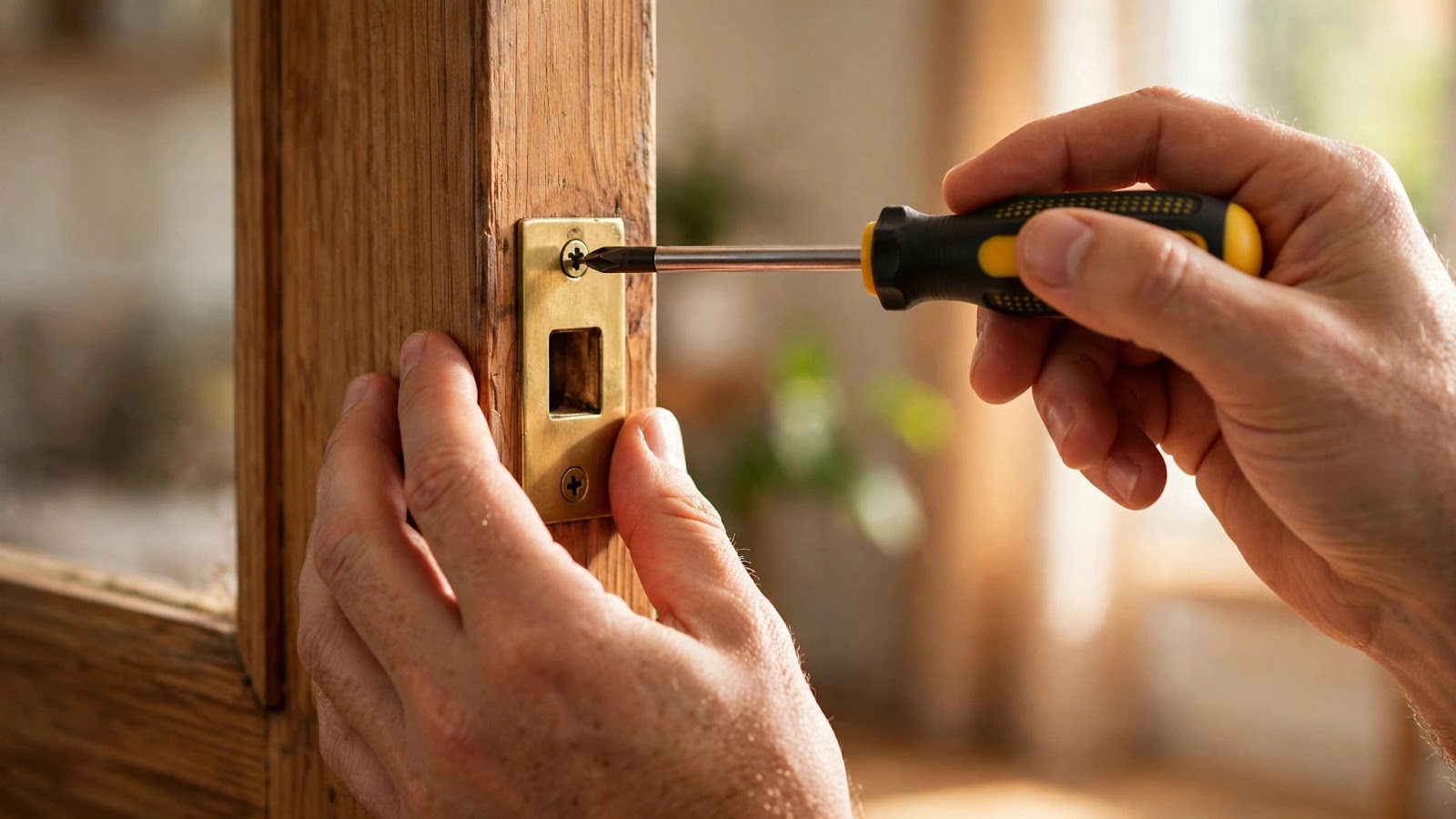
Drop the cardboard shim into the mortise, set the plate back on top, and screw it back down. Here's the key detail: tighten the screws evenly and snugly, but don't gorilla them. Over-tightening crushes the cardboard unevenly and can crack the frame wood around old screw holes. Snug is the word. Now close the door and test. The plate now sits a hair closer to the door — that fraction of an inch is often all the latch needs to catch cleanly.
Mine caught on the first try after one layer of cereal-box cardboard. One layer. Eleven minutes including the diagnosis. I stood there opening and closing the door like a weirdo for a full minute, just enjoying the click. If one layer isn't enough, add a second. If the door then rubs or the latch is hard to retract, you've gone too far — remove a layer. It's completely reversible, which is the best kind of fix.
When the plate needs to move, not just come forward
Sometimes the latch misses sideways — it hits the plate too high or too low by more than a shim can fix, or it needs to move left or right. This is where it gets slightly more involved, but still firmly in beginner territory. If the latch hits too high or low by more than about 1/8 inch, the clean fix is to move the strike plate itself: unscrew it, fill the old mortise spot or just enlarge the opening in the right direction, and reposition.
The practical way: unscrew the plate, then use the tape-and-marker trick to find where the latch actually lands. Mark the new position on the frame. If you're moving the plate up or down less than the width of the opening, you can often just file the top or bottom of the plate's hole with a small metal file to widen it in the right direction — no woodworking needed. I did this on a closet door once where the latch was grazing the top edge of the opening; five minutes with a file and it clicked perfectly.
For bigger moves, you re-cut the mortise. Trace the plate in its new position, then deepen the recess with a sharp chisel or a utility knife, working carefully and testing the fit often. Take off less wood than you think — you can always remove more, and a mortise that's too deep just gets a cardboard shim (funny how it all comes back to cardboard). This sounds scarier than it is. You're removing maybe 1/16 of an inch of wood.
Don't forget the hinges (my actual root cause)
Here's the part of the story I skipped: about two months after my cereal-box shim fixed the latch, the door started drifting out of alignment again. The shim was still in place, but the latch was missing low once more. That told me something was moving — the door was sagging, and the shim had just been compensating for it.
The culprit was the top hinge. On most interior doors, the top hinge carries almost all the weight, and its screws are usually the standard 3/4-inch screws that come with the hardware — barely long enough to bite into the frame's soft pine. Over years of swinging, they loosen, and the door drops a fraction of an inch. The tell: look at the hinge screws. If any spin freely or sit slightly proud of the hinge leaf, they're stripped or loose.
The fix is almost insultingly simple: replace one or two of the short hinge screws with 2.5 or 3-inch screws that reach through the frame and into the wall stud behind it. Remove one short screw at a time (don't take the whole hinge off), drive the long screw in its place with your drill or screwdriver. The long screw pulls the hinge — and the door — back up tight. On my door, two long screws in the top hinge lifted the latch a full eighth of an inch, and I could have removed the cardboard shim entirely. I left it in, because the door latches like a bank vault now and I'm not touching it again.
So the real lesson: if your door needed a shim once and drifts again, check the hinges before adding more cardboard. The shim fixes the symptom; the hinge screws fix the cause. I now check hinge screws on every door in the place once a year — it takes five minutes and prevents exactly this slow-motion failure.
Seasonal sticking vs. latching problems

Worth a quick distinction, because the fixes are different. If your door latches fine but rubs or sticks against the frame in summer, that's humidity swelling the wood — a different problem. Don't shim for that; don't plane the door either, at least not first. Try running the AC or a dehumidifier for a few days and see if it resolves. If it sticks year-round, a swipe of paraffin wax or a candle along the rubbing edge often fixes it. I keep a stub of an old candle in the junk drawer specifically for sticky doors and drawers. It works embarrassingly well for something that sounds like folk magic.
And if your door rattles in the frame when closed — latches, but loosely, so it buzzes every time someone walks by — that's a strike plate that's too far from the door rather than misaligned. The fix is the opposite of a shim: you want the plate's opening tighter, or you bend the little metal tab inside the strike plate (most plates have one) slightly outward with a screwdriver so it grips the latch bolt. Two seconds, no parts.
What I'd do if it were my door
Honestly? Do the tape-and-marker test first — it takes a minute and tells you exactly what's wrong instead of guessing. Then shim the strike plate with cardboard, because it's free, reversible, and works most of the time. While you're at it, check the top hinge screws and swap in long ones if they're loose. Between those two steps, you've fixed the symptom and the cause, for a total cost of roughly zero dollars and about fifteen minutes.
What I would NOT do: don't start by rehanging the door, don't take the door off its hinges, and definitely don't take a plane or sander to the door edge as a first move. Every one of those is irreversible in a way that cardboard is not. Doors are forgiving if you work from the smallest fix upward. Mine went from "swings open during video calls" to "clicks shut like new" with a cereal box and two screws, and I still think about that ratio of effort to result every time I close it.
While you're at it: the free security upgrade
Since you've already got the screwdriver out and you're staring at the strike plate, here's something worth doing that has nothing to do with latching: upgrade the strike plate screws. The screws holding most interior strike plates are those same stubby 3/4-inch screws that barely bite into the frame. On an exterior door — your front door, back door, any door with a deadbolt — short strike plate screws are a genuine security weakness. A hard kick can split the soft frame wood right around them.
The fix is the same long-screw trick as the hinges: swap the short screws for 3-inch screws that reach the wall stud behind the frame. It costs maybe a dollar in screws and takes two minutes, and it dramatically increases how much force the locked door can take. I did this on my front door's deadbolt strike plate the same afternoon I fixed the bedroom door, because once you know the trick you start seeing short screws everywhere. This is one of those rare home improvements that is simultaneously free, fast, and actually meaningful.
A quick note on scope: this matters for exterior doors with deadbolts. For interior bedroom and bathroom doors, the standard screws are fine — nobody's kicking down a bathroom door, and if they are, you have bigger problems than screw length. But if your bedroom door is your "safe room" door or you just want the peace of mind, the long screws work the same way there.
When the door won't stay closed (a different problem)
One more distinction worth making, because people confuse these constantly: a door that won't LATCH (the bolt doesn't catch) is different from a door that latches fine but drifts open on its own, or a door that won't stay closed because it's warped or the house has settled. If your door closes and latches but then slowly swings open, the frame is probably out of plumb — the door is literally sliding downhill. No strike plate adjustment fixes gravity.
For a drifting door, the classic fix is bending a hinge pin: remove one hinge pin, lay it on concrete, and tap it gently in the middle with a hammer to put a slight bend in it, then tap it back in. The bend adds friction that holds the door wherever you leave it. It sounds like a hack because it is one — but it's a hack that carpenters have used for a century, and it works. Alternatively, a small magnetic cabinet catch screwed to the top of the frame holds a drifting door shut for a few dollars. I put one on a linen closet door that insisted on creeping open every night, and three years later it's still holding.
The point is: diagnose before you fix. Latch misses the plate? Shim. Door sags? Hinge screws. Door drifts open on its own? Hinge pin or magnetic catch. Door sticks in the frame? Humidity or wax. Each one is a fifteen-minute fix if you pick the right one, and an afternoon of frustration if you pick the wrong one. The tape-and-marker test at the start of this article is what keeps you honest.


