My bedroom door squeaked for four months. Every time I opened it, every time I closed it, every time someone went to the bathroom in the night — eek, eek, eek, like a tiny mouse being stepped on. I heard it a hundred times a day and did nothing about it, because in my head, fixing a door hinge was a Job. It needed the right product, the right tools, a trip to the hardware shop, and a free afternoon. I had none of those, so the door kept squeaking.
Then one Sunday morning, my partner said something that shamed me into action. "Are we going to live with this forever, or are you going to do something about it?" I opened the cupboard under the bathroom sink, looked at what I actually had, and fixed the door in five minutes with a dab of petroleum jelly on my fingertip. Five minutes. Four months of squeaking, ended by something that had been sitting in my bathroom the whole time.
This is the story of that fix — what worked, what did not, and the one hinge that petroleum jelly could not save. If you have a squeaky door in your house right now, you are five minutes from silence. Probably with something you already own.
Four months of living with a squeak
The squeak started small. A faint protest when the door swung past halfway. I noticed it, thought "I should deal with that," and then did not deal with it. That is how most household annoyances survive: not because they are hard to fix, but because they are easy to postpone.
Over the weeks, it got worse. Hinges do not heal themselves. The squeak grew louder and sharper, until it was the first thing you heard when you came into the room and the last thing you heard at night. My partner started closing the door with an exaggerated slow-motion push, as if gentleness could negotiate with metal. It could not. The door squeaked at every speed.
What stopped me fixing it was not laziness, exactly. It was a wrong idea about what the fix required. I believed I needed WD-40. Everyone says WD-40. You spray it, the squeak stops, job done. I did not have any WD-40. Buying some meant a trip to the shop, and a trip to the shop for one small can felt like a project. So the door kept squeaking, held hostage by my belief that only one product could fix it.
This is a pattern I have noticed in myself around the house. I postpone small repairs because I imagine them needing specialist supplies, when most of them need whatever is already in the cupboard. The squeaky hinge was my wake-up call. Now, whenever something small breaks, my first question is: what do I already have that could do this?
What I had, and what I used
Here is the full inventory of the repair: one small tub of petroleum jelly from the bathroom cabinet, one fingertip, one flat-head screwdriver, one old tea towel, and five minutes. That is the whole list. No spray can, no specialist lubricant, no trip to the shop.
Petroleum jelly works on hinges because of what it actually is: a thick, stable grease that stays where you put it. A squeaky hinge is usually two pieces of dry metal rubbing against each other — the hinge pin rubbing inside the knuckle of the hinge. What it needs is lubrication that stays put. A thin spray runs off or dries out. A dab of thick jelly sits in the joint and keeps the metal surfaces sliding quietly against each other.
I want to be honest about something: I did not invent this. I had read it somewhere years ago and filed it away under "things to try one day." One day turned out to be the Sunday my partner lost patience. The idea had been sitting in my head as long as the jelly had been sitting in the cabinet. Both were waiting for me to actually use them.
Before I started, I put the tea towel on the floor under the hinge. This was not fussiness. Petroleum jelly stains, and a smear on a carpet or a wooden floor is a second repair you did not need. A towel takes three seconds to lay down. Lay it down.
The five-minute fix, step by step
First, I worked out which hinge was squeaking. This sounds obvious, but doors have two or three hinges, and only one is usually the culprit. I opened and closed the door slowly, listening, with my hand resting lightly on each hinge in turn. The middle hinge was the noisy one — I could feel the faintest vibration through it as the door moved. If you cannot tell by listening, do this: put a fingertip on each hinge while someone else moves the door. The squeaky one gives itself away.
Second, I lifted the hinge pin. This is the part that sounds technical and is not. A door hinge pin is the metal rod that runs down through the middle of the hinge, holding the two halves together. On most interior doors, you can tap it upward from underneath with a flat-head screwdriver and a light tap from your palm. It slides up and out. I tapped gently, caught the pin as it rose, and pulled it free.
Two warnings from experience. One: do the bottom hinge first if you are removing a pin entirely, or better still, do one hinge at a time and leave the other hinges in place holding the door. I only removed the pin from the middle hinge, and the top and bottom hinges kept the door steady. Never take all the pins out at once unless the door is off and lying flat, or you will be holding a door and regretting your life choices. Two: if the pin is stiff, do not force it. A drop of cooking oil around the top of the pin, ten minutes of patience, and a gentle wiggle will free most stubborn pins.
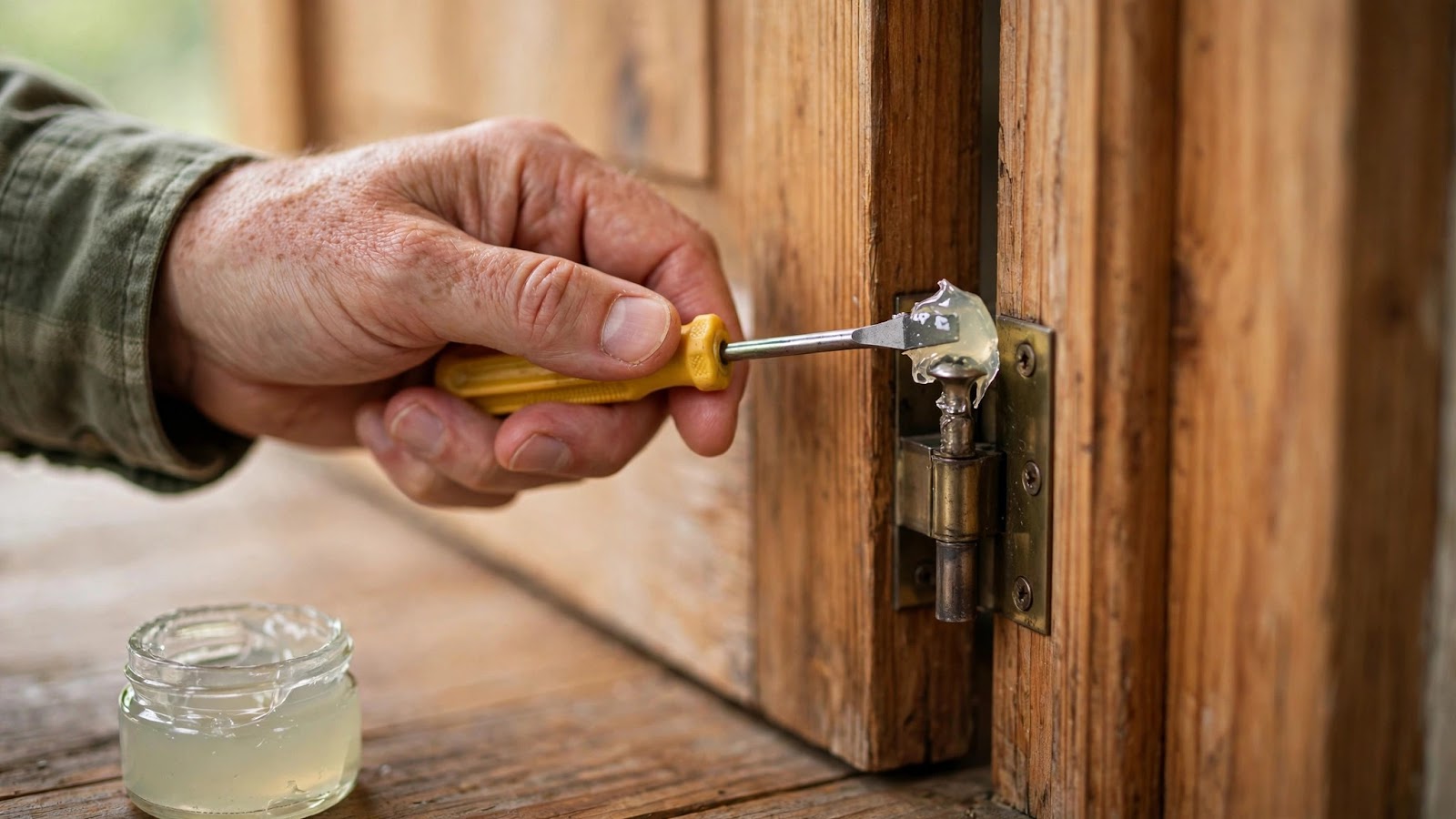
Third, I cleaned the pin. It was duller than I expected, with a thin film of grey dust and old grime. I wiped it with the tea towel until it was clean and smooth. This step matters more than people think. Rubbing fresh grease onto a dirty pin just traps the grit in the joint, and grit is the enemy of quiet hinges.
Fourth, the actual fix. I scooped a pea-sized dab of petroleum jelly onto my fingertip and smeared it along the pin, a thin, even coat from top to bottom. Pea-sized is plenty. You are lubricating a joint, not icing a cake. Too much jelly just squeezes out and makes a mess when you put the pin back.
Fifth, I slid the pin back in, from the top, and tapped it gently down with the screwdriver handle until it sat flush. Then I opened and closed the door. Silence. Total, immediate, ridiculous silence. I opened and closed it four more times just to enjoy it. My partner came in from the other room and said, "What did you do?" I said, "Five minutes. I fixed it in five minutes."
The lazy version, for hinges you cannot be bothered to dismantle
Since that Sunday, I have fixed three more squeaky hinges in the house, and I have learned that the pin-removal method is the gold standard — but there is a lazier version that works nearly as well, and I use it when I am in a hurry.
The lazy version: leave the pin in place. Scoop a small dab of petroleum jelly onto your fingertip and work it into the top of the hinge, right where the pin meets the knuckle. Then swing the door back and forth ten or twelve times. The movement works the jelly down into the joint. Wipe away whatever squeezes out. Done. It takes about a minute, and for a mildly squeaky hinge, it is often enough.
I used this on the bathroom door, which had a faint squeak, and it has been quiet for months. But I would not use it on a badly squeaking hinge, because the jelly does not reach as far into the joint. For the bedroom door — the one that had been squeaking for four months — the full pin removal was worth the extra three minutes. Use the lazy method for a whisper. Use the full method for a scream.
One more trick for the lazy version: if the hinge has a little gap at the top, you can use a cotton bud to push the jelly down into it. A cotton bud reaches further than a fingertip and puts the grease exactly where it needs to go. I keep a few in the toolbox now, specifically for this.
What about WD-40, cooking oil, and the rest?
People always ask me: is petroleum jelly actually better than the alternatives? Here is my honest answer, from trying several of them around the house.
WD-40 is fine for a squeak, and if you already have a can, use it. But WD-40 is mainly a water displacer and a light penetrant, not a long-lasting lubricant. In my experience, a WD-40 fix on a hinge lasts weeks, not months. It is thin, it runs, and it dries out. It is brilliant for freeing a stiff, rusty pin. It is less brilliant as a permanent hinge lubricant. If you use it, follow up with something thicker afterwards.
Cooking oil works in a pinch. I used a drop of olive oil on a garden gate hinge once, and it went quiet immediately. Two weeks later it was squeaking again, and the oil had gone slightly sticky. Vegetable oils can go rancid and gummy over time, which is not what you want inside a hinge. If cooking oil is all you have, use it — a quiet hinge today beats a squeaky one — but plan to redo it with something better.
Candle wax is a trick I have heard but never needed. You rub a little wax on the pin, and the friction melts it into the joint. It works, apparently. Petroleum jelly is easier, cleaner, and already in my bathroom. I have not found a reason to switch.
The real lesson is that the product matters less than the principle: a squeaky hinge needs thick, stable lubrication inside the joint, and it needs the joint to be clean first. Petroleum jelly happens to be the thick, stable lubricant most of us already own. That is why it wins.
The hinge that petroleum jelly could not save
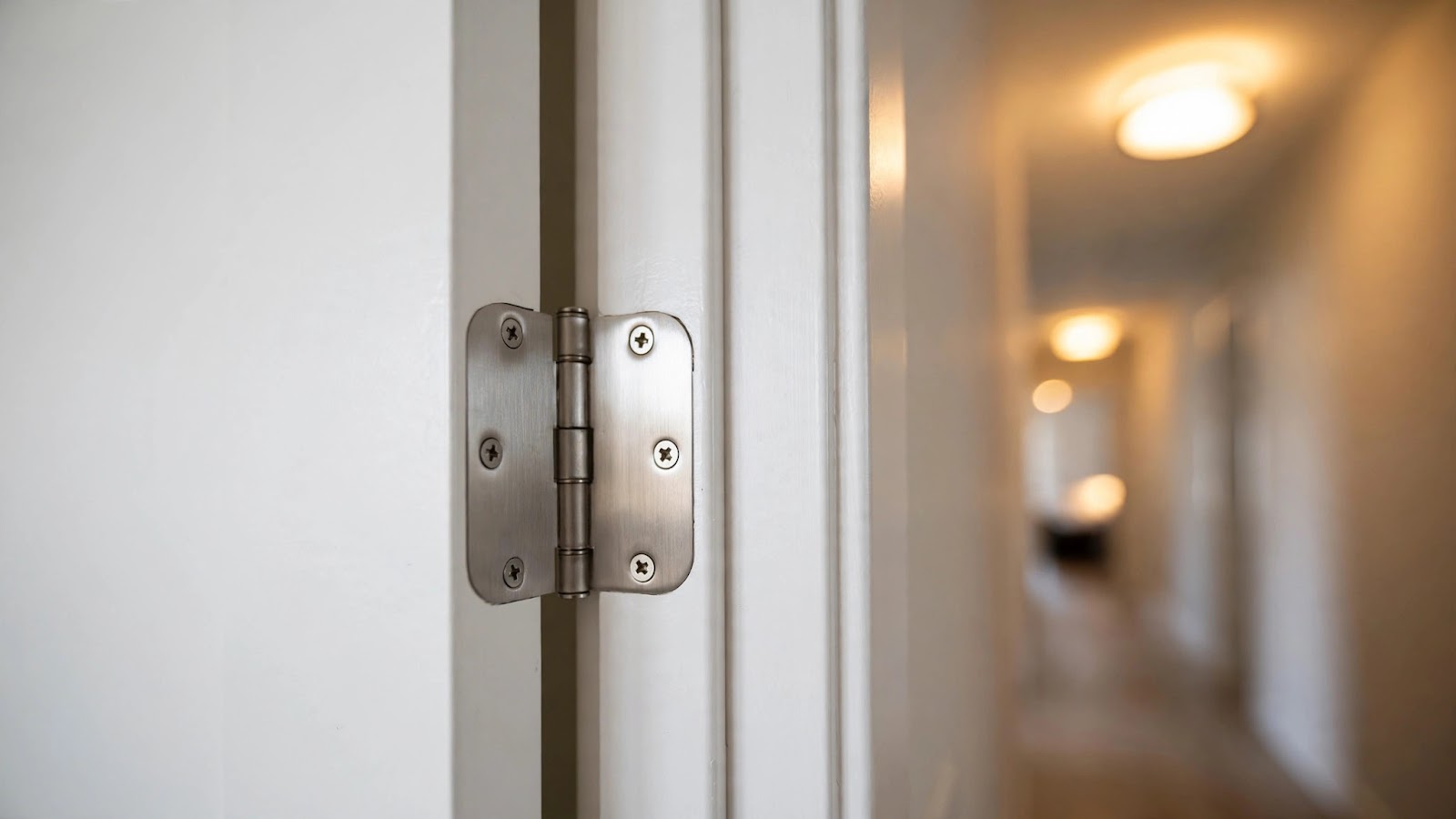
I wish this story ended with every hinge in the house fixed. It does not. The kitchen door had a squeak too, and when I pulled its pin out, I found the real problem. The pin was bent — not dramatically, but enough to see when I rolled it on the countertop. It wobbled instead of rolling straight. And the hinge itself was loose: one of the screws turned endlessly in its hole, gripping nothing.
No amount of jelly fixes a bent pin. The pin was grinding against the hinge knuckle at the wrong angle, and lubrication could only muffle the symptom. And no amount of jelly fixes a screw that has stripped its hole. That door was moving slightly in its frame every time it swung, and the movement was the squeak.
So the kitchen door got a different repair. I bought a replacement hinge — the same size, about £4 from the hardware shop — and two slightly longer screws for the stripped hole. The longer screws bit into fresh wood behind the old hole and held firm. I fitted the new hinge, gave the new pin a dab of petroleum jelly before it went in, and the door has been silent ever since.
Here is how you tell whether your hinge is a jelly job or a replacement job. Pull the pin and look at it. Roll it on a flat surface. If it rolls straight and smooth, jelly will fix it. If it wobbles or looks bent, replace it. Then check the screws. If a screw turns without tightening, the hole is stripped — try a longer screw, or fill the hole with a wooden golf tee or a sliver of dowel glued in place, let it dry, and screw into that. If the hinge leaves are bent or cracked, or the hinge is rusted through, replace the whole hinge. It is a fifteen-minute job, and it is the honest fix.
Knowing when a quick fix is not enough is part of being handy. The jelly is not magic. It is grease. Grease fixes friction. It does not fix damage.
Keeping hinges quiet for good
Since the bedroom door went quiet, I have added hinges to my twice-a-year house routine. Every spring and autumn, when I do the other small jobs — checking the smoke alarm, cleaning the filters — I walk around the house with the tub of petroleum jelly and check every door. Open, close, listen. Any hinge that whispers gets a dab before it becomes a scream.
Prevention is faster than cure. A hinge that gets a fingertip of jelly once a year never gets the chance to squeak. The whole round takes ten minutes for the entire house, and it has kept every door quiet since that Sunday. The bedroom door, the one that squeaked for four months, has not made a sound since.
I also pay attention to the doors that get used the most. The bathroom door and the front door take the most swings, and they are the first to complain. If you only have two minutes, do those two first. And if you have a door that sticks or drags as well as squeaking, check the screws before you reach for the jelly — a dragging door is usually a loose hinge or a swollen door, and grease will not fix either.
The five-minute rule
This repair taught me something bigger than hinge maintenance. I now have a rule for the house: if a job takes less than five minutes, I do it now. Not this weekend. Not when I get around to it. Now.
The rule exists because I finally understood what four months of squeaking actually cost me. Not money. Not effort. Attention. Every squeak was a tiny interruption, a small spike of irritation, a reminder of a job I had not done. Multiply that by a hundred squeaks a day, across four months, and the cost was enormous — paid in mood, not in cash.
Most of the small repairs in a house are like this. The loose handle. The dripping tap. The drawer that sticks. The squeaky hinge. Each one takes minutes to fix and months to get around to, and the months are the expensive part. The fix is cheap. The postponement is what costs you.
So here is my challenge to you. If you have a squeaky door — and you probably do, because everyone does — go and fix it now. Grab the petroleum jelly from the bathroom. Put a towel under the hinge. Pull the pin, clean it, grease it, slide it back. Open and close the door. Listen to the silence. Then enjoy the strange, disproportionate satisfaction of a job that took five minutes and four months, finished at last.
I promise you: the silence is worth it.


