Getting bonked in the forehead by your own kitchen cabinet is a special kind of humiliation. It happened to me twice — same door, same cabinet, reaching for the pasta. The second time I actually said "okay, that's a sign" out loud to an empty kitchen and closed the door. It swung right back open and stopped an inch from my nose, like it was mocking me.
The door wouldn't stay shut. You'd close it, feel that satisfying little thunk, turn around — and hear the soft click of it drifting back open behind you. Not dramatically. Just a slow, lazy two-inch gap.
I put up with it for weeks. Then I fixed it in ten minutes with a screwdriver I already owned and a three-dollar pack of screws. If your cabinet door is doing the same slow-drift thing, this is almost certainly your problem too.
First: Figure Out What Kind of Hinge You're Dealing With
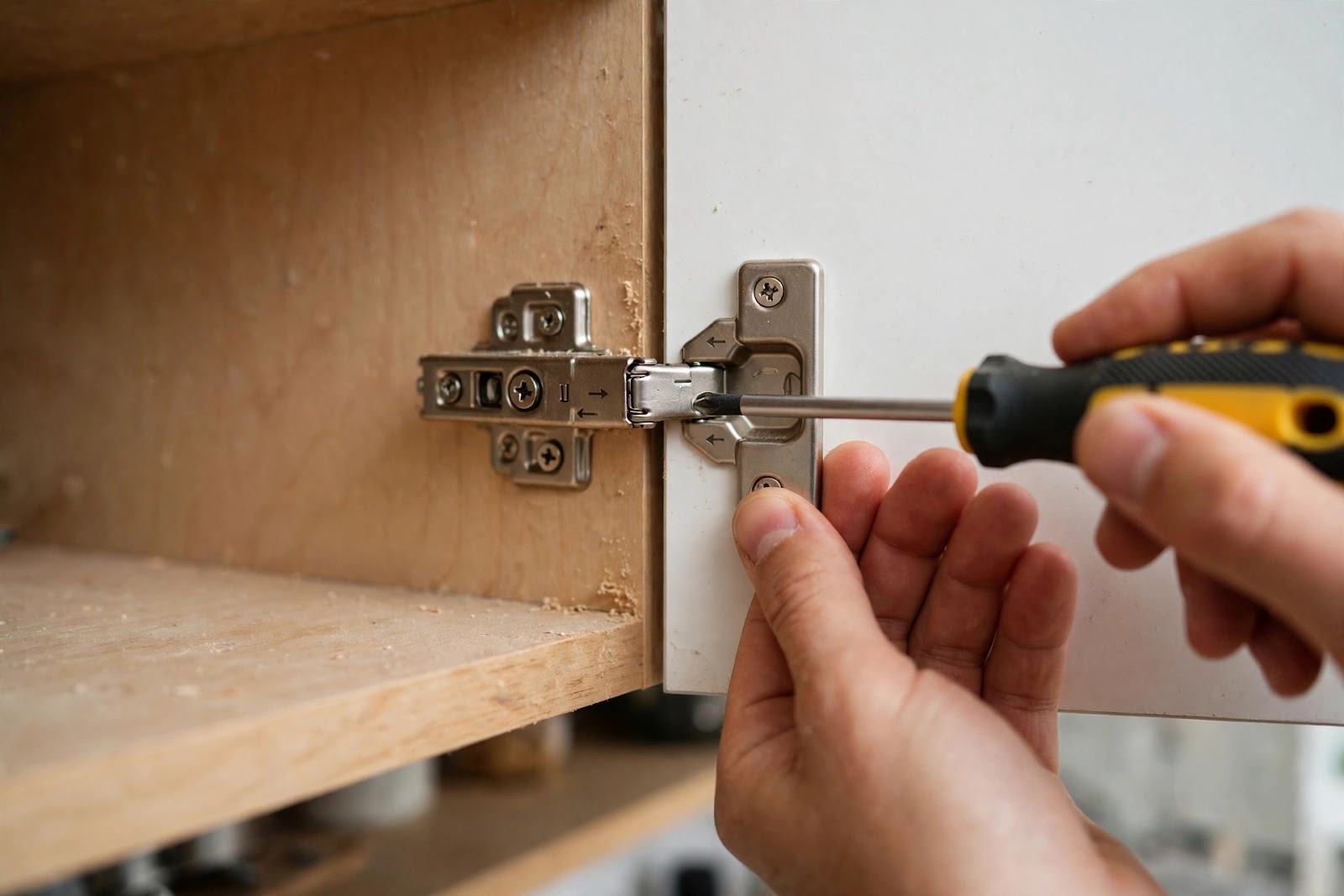
Open the offending cabinet and look at the hinge. If it's a little silver metal contraption tucked inside the cabinet — a cup sitting in a round hole on the door, with an arm that bolts to the cabinet frame — you've got a European-style concealed hinge. These are the standard hinge on basically every cabinet built in the last forty years, and they have a superpower most people never learn about: they're fully adjustable.
Silver, with two Phillips screws on the arm. No brand markings I could see. The adjustment system is nearly universal across brands.
Quick diagnostic before you touch anything: close the door and look at the gap between the door and the cabinet frame. On my pasta cabinet, the gap was even at the top and pinched shut at the bottom — the door was leaning, rubbing on the frame near the bottom corner. That lean is what was keeping it from latching. The door was resting against the frame with enough pressure to push itself back open, like a spring.
The Two Screws That Run the Whole Show
Every European concealed hinge has two adjustment screws, and understanding which is which took me about five minutes of staring. Here's the cheat sheet:
The deep screw (usually the inner one, sometimes at the front of the arm): this moves the door in and out — toward you or away from the cabinet. Turning it pulls the door closer to the frame or lets it float forward. On many hinges you adjust this one by loosening it, repositioning the door by hand, and tightening again.
The side screw (usually the rear one, sitting on top of the arm): this slides the door left and right, parallel to the cabinet face. This is the one that fixes rubbing against the frame, and it was the whole game on my door.
Some hinges have a third screw for vertical adjustment (up/down) on the mounting plate. Mine did, and I didn't need it, but good to know it's there if your door is riding too high or low.
The beautiful part: these are adjustment screws, not structural ones. You cannot break anything by turning them. That's the part nobody told me and the reason I waited weeks to try. I was worried I'd unscrew something load-bearing and have the door fall off in my hands. You won't. The hinge arm is held to the mounting plate separately; the adjustment screws just shift the door's position within the arm.
Diagnose the Drift Before You Grab the Screwdriver
This took me longer than the actual fix, so pay attention. Stand back and watch the door fail. Really watch it.
Close the door gently — not a slam, a normal close — and observe what happens. If it drifts open on its own like mine did, ask: what's pushing it? A cabinet door doesn't open by itself. Something is putting pressure on it. Nine times out of ten, that something is the door rubbing against the cabinet frame or against a neighboring door.
Look at the gaps. Close the door and check the reveal — that's the little gap between the door and the frame, or between two doors if they're paired. It should be roughly even all the way around, usually about an eighth of an inch (3mm).
On my door the reveal was even across the top and vanished at the bottom. The bottom corner was kissing the frame. That's side-adjustment territory: the door needed to shift toward the hinge side, away from the frame it was rubbing.
If your door drifts open but the gaps look even, the door might be sitting too far forward — out away from the cabinet — so the magnetic catch or the soft-close mechanism can't grab it. That's the depth screw's job. Pull the door in toward the frame and the latch engages again.
The Actual Fix: Ten Minutes, One Screwdriver
Here's exactly what I did, step by step. Grab a #2 Phillips — the regular one in everyone's junk drawer.
Step one: open the door all the way so you can reach both hinges. Most cabinet doors have two hinges (tall doors have three — adjust all of them the same amount).
Step two: find the side screw on the top hinge. On mine it was the rear screw on the hinge arm, clearly visible. Give it a half turn clockwise and watch what the door does. On my hinges, clockwise pushed the door toward the hinge side — away from the rubbing frame. Yours might go the other way; watch the gap.
Step three: do the same adjustment on the bottom hinge, roughly the same amount. This keeps the door parallel. If you only adjust one hinge, the door tilts and you'll be chasing the problem up and down the frame all afternoon.
Step four: close the door and check the reveal. Is the gap even now? Does the door close and stay closed? On mine, after a half turn on each hinge, the bottom corner cleared the frame — and the door clicked shut like it had always done.
Step five: fine-tune. Mine needed about a quarter turn more on the bottom hinge because the gap was slightly wider at the top. Close, check, tweak. You're done when the gaps look even and the door stays put.
Elapsed time: ten minutes, including two spent hunting for the screwdriver.
The Three-Dollar Twist
So why does the title say three dollars when the fix was free? Because my top hinge had a secondary problem I only found while adjusting it. The two wood screws holding the hinge's mounting plate to the cabinet frame were stripped — someone before me had overtightened them, and the plate wobbled slightly no matter how I set the adjustment screws. A wobbling hinge means the door position drifts over time, and I'd have been re-adjusting every few months.
The fix was a small pack of #8 x 3/4" wood screws from the hardware store: $2.99 plus tax. I swapped the two stripped screws on that plate, the hinge went rock solid, and the adjustment held. If your hinge plates are tight already, skip this entirely — your cost is zero dollars and ten minutes.
Honestly, check your mounting screws first. A door that won't stay shut is usually an adjustment problem, but if the hinge itself is loose on the frame, no amount of screw-turning will fix it. Wiggle each hinge with your finger. Solid? Adjust. Wobbly? Replace the screws first, then adjust.

What About the Little Magnetic Catch Inside?
Some cabinets don't rely on the hinge alone — they have a small magnetic catch or a touch latch screwed inside the cabinet frame that holds the door shut. If yours has one, give it a look before you blame the hinges.
A magnetic catch only works when the door sits close enough for the magnet to grab the little metal plate on the door. If the door has drifted outward even a few millimeters — the depth-screw problem from above — the magnet's pull gets too weak to hold it, and the door drifts open. I checked mine: it had a cheap roller catch, not a magnet, and the roller wasn't even touching the door anymore because of the drift. Once I adjusted the hinges, the roller engaged again and started doing its job.
If your cabinet has a touch latch (push-to-open type), those are fussier. They need the door positioned within a very narrow sweet spot. If a touch latch stops catching, it's almost always a depth adjustment issue — the door moved a hair too far forward. Nudge it inward a quarter turn at a time until the latch clicks again.
And if the catch itself is just worn out? A replacement magnetic catch costs about two dollars at any hardware store, two screws, done. But adjust the door position first. Most "dead catches" are really just doors that drifted out of range.
How the Door Got Crooked in the First Place
Worth knowing, because you'll check your other cabinets after this (I did, and found two more doors that were slightly off). Cabinet doors drift for boring, ordinary reasons.
Humidity moves wood. If your kitchen sees real cooking steam — and mine does, I'm not one of those people with a decorative stove — the doors swell and shrink with the seasons. Summer humidity swells them slightly, winter dryness shrinks them. Over a few years, a door can wander a millimeter or two, which is all it takes for a rubbing corner to develop.
Kids and heavy use also contribute. My pasta cabinet is the one I slam when I'm in a hurry. Every impact shifts the door a tiny bit on its mounting screws. Ten years of that adds up.
The point: this isn't a one-time fix. Every year or two, give your cabinet doors a quick once-over. Close each one, glance at the gaps, tweak anything that's rubbing. It takes less time than cleaning out the spice drawer, and it keeps the forehead-bonking incidents at zero.
If Your Cabinets Are Soft-Close (Lucky You)
Newer cabinets have a soft-close mechanism built into the hinge — a little damper that catches the door in the last inch and glides it shut. If yours have this and the door still drifts open, the damper probably isn't engaging, and the fix is the same depth adjustment: the door sits too far forward for the damper to grab it.
Look for a small gray tab or button on the hinge arm. Many soft-close hinges let you toggle the feature off for adjustment and click it back on afterward. Turn the depth screw until the door pulls itself that final half inch and settles with the little cushioned stop. If the damper itself is broken — the door slams instead of gliding — a soft-close retrofit adapter clips onto most standard hinges for a few dollars each, no new hinges needed.
What I'd Tell My Past Self
The thing that kept me from fixing this for weeks was the fear of making it worse. Cabinet hinges look precision-engineered and expensive. They feel like a thing you hire someone for. But European concealed hinges were literally designed so installers could tweak them on-site with one screwdriver — the whole adjustment system exists because cabinet doors shift, houses settle, and humidity moves wood. My door wasn't broken. It had just drifted a couple of millimeters over the years, exactly the way these hinges expect.
If your cabinet door bonks your forehead while you're reaching for the pasta, don't be like me and take the second hit before acting. Grab the screwdriver, find the side screw, and give it a half turn. The door will click shut, stay shut, and you'll wonder why you ever thought this was a professional's job.


