For one week last winter, my smoke detector chirped at 2am. Every single night. One chirp, sharp enough to drag me out of sleep, then silence — until the next night. I lay there the first two nights telling myself I'd deal with it in the morning. By night four I was Googling "smoke detector chirping" at 2:15am with the haunted expression of a man who'd forgotten what uninterrupted sleep felt like.
The obvious fix — new batteries — didn't work. I swapped them on night five, triumphant, and got chirped at 2am on night six anyway. That's when I learned the chirp has more causes than a dead battery, and that the real fix involved cleaning the contacts, checking the detector's age, and — this is the embarrassing part — using a proper ladder instead of a wobbly dining chair.
This is the full story: what the chirp means, every fix in order, the ladder lesson I learned the hard way, and the monthly checklist I use now so it never happens again. If your detector is chirping tonight, start at the second section. If it's quiet, read the whole thing anyway — future you will be grateful.
What that chirp actually means
A single chirp every 30 to 60 seconds is your detector's way of saying "something needs attention" — and it's deliberately annoying, because the engineers who designed it knew you'd ignore anything gentler. The most common cause is a low battery, but it's not the only one, and that's where most people (including me) go wrong: they swap the battery, the chirp continues, and they conclude the detector is broken.
Here's the full list of usual suspects, roughly in order of likelihood. Low or dying battery — the classic. Battery contacts that are corroded or dirty, so even a fresh battery can't make a good connection. Dust or insects inside the sensing chamber, which confuses the sensor. A detector that's past its lifespan — most last about ten years, and an expired unit chirps no matter what you feed it. And loose wiring on hardwired models, where the backup battery chirps because the mains connection is flaky.
There's also the pattern distinction worth knowing. One chirp every minute or so: attention needed (battery, dust, age). Three or four loud beeps in a repeating pattern: that's the actual alarm — get out, don't troubleshoot. Continuous chirping that won't stop: could be the end-of-life warning on newer models. My nightly visitor was the classic single chirp, roughly every 45 seconds. Attention needed. Fine. Attention it would get.
The battery swap that failed
Night five. Armed with a fresh 9-volt battery (I'd bought a two-pack — £4.50, a leading brand, because I wasn't taking chances), I stood on a dining chair, twisted the detector off its base, and swapped the battery with the confidence of a man who'd solved the problem. I pressed the test button. It beeped obediently. I went to bed smug.
2:07am. Chirp.
I want you to understand the specific despair of that moment. I'd done the thing. The obvious thing. The thing every article says to do. And the chirp was still there, mocking me from the hallway ceiling. I stood in the dark hallway in my pyjamas, staring up at this small white disc, genuinely angry at an inanimate object. Then I did what I should have done on night one: I actually investigated instead of assuming.
First discovery: the old battery I'd removed tested fine on my multimeter. 8.9 volts — barely used. So the battery was never the problem, or at least not the whole problem. Second discovery, when I looked closely at the battery compartment with my phone torch: the metal contacts had a faint greenish tinge. Corrosion. Light, but there. The fresh battery had been sitting on a dirty contact, making an intermittent connection — enough to pass the test button, not enough to keep the low-battery circuit happy through the night.
The fix took ninety seconds. I removed the new battery, rubbed the contacts firmly with a pencil eraser — the abrasive rubber cleans oxidation beautifully — then wiped them with a dry cloth. Reinserted the battery with a firm click. Test button: beep. That night: silence. Glorious, total silence. I nearly cried.
The ladder lesson (do not stand on dining chairs)
Now the part I'm least proud of. For that entire week of battery swaps and contact cleaning, I was standing on a dining chair. A wooden dining chair, on a hard hallway floor, reaching above my head to fiddle with a ceiling-mounted device. Every safety instinct I own was screaming, and I ignored it because the stepladder was in the garage and it was 2am and I just wanted the chirping to stop.
On night six — the night of the failed battery swap — the chair wobbled as I twisted the detector back onto its base. Not dramatically. Just a small sideways shift, enough to send a jolt of adrenaline through me as I grabbed the doorframe. I froze there for a good ten seconds, one hand on the detector, the other white-knuckled on the frame, thinking about how stupid it would be to end up in A&E because of a smoke detector.
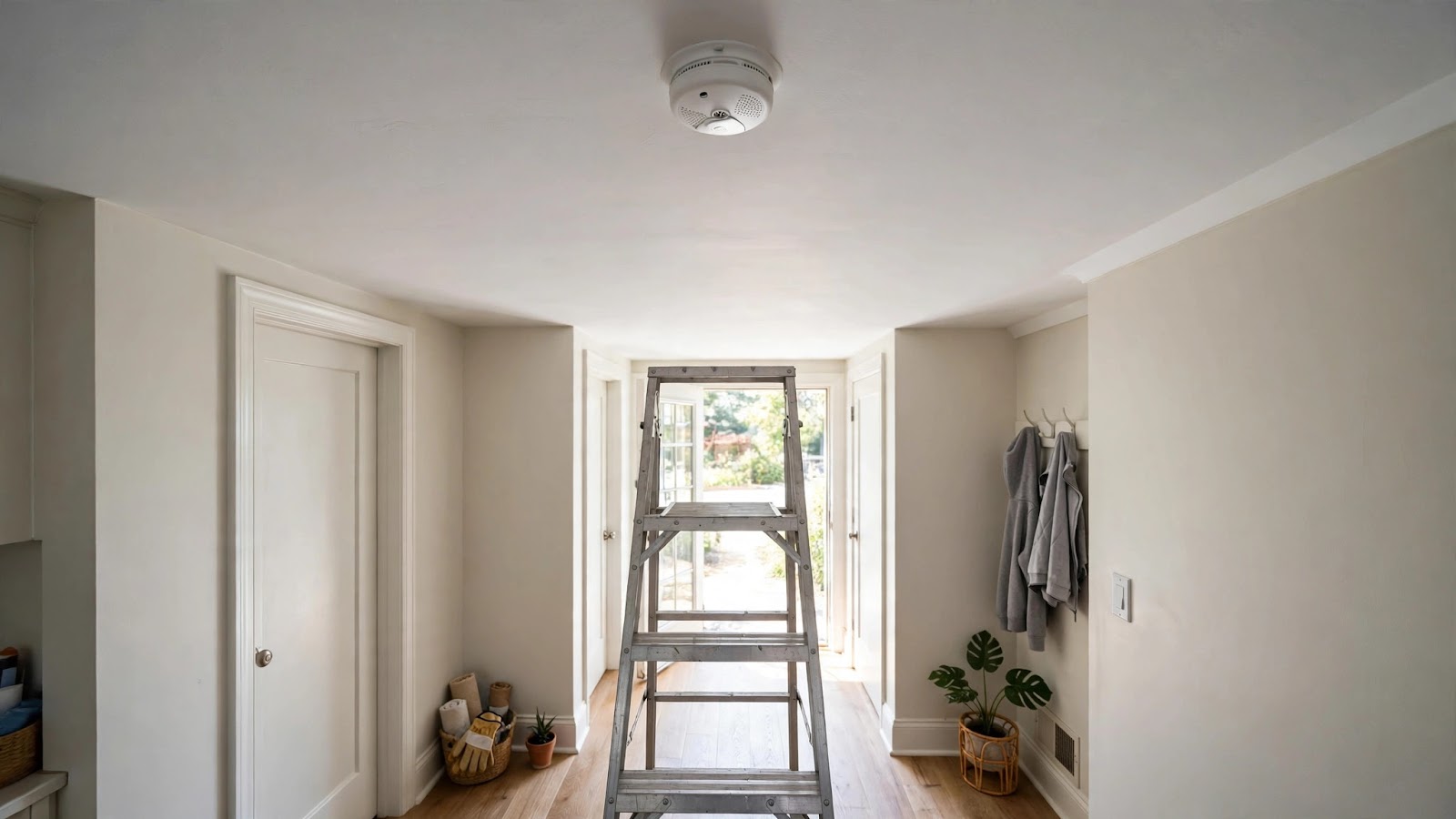
The next morning I bought a proper stepladder. A simple three-step folding one — £35 from the hardware shop, nothing fancy. It lives in the understairs cupboard now, not the garage, because "it's in the garage" was the excuse that put me on the chair in the first place. If the tool you need is inconvenient to reach, you'll use the wrong tool. Make the right tool the easy choice.
I'm telling you this because I know some of you are standing on chairs right now, metaphorically or literally. Ceiling work means a stable platform, full stop. A wobble at height while your hands are busy is how falls happen, and falls from even a metre can do real damage. The £35 ladder is the cheapest safety upgrade in my entire house. Buy one before you need it.
The full checklist (in order)
If your detector is chirping, work through this list top to bottom. Don't skip steps — I skipped straight to "replace the whole unit" in my head on night six, which would have cost me £25 and solved nothing, since the unit was fine.
Step one: replace the battery, even if you think it's fine. Use a fresh, name-brand battery and check the expiry date on the packet — shop-bought batteries can sit on shelves for ages. Note the type: most take 9-volt, but some take AAs or a sealed lithium cell. Match what's already in there.
Step two: clean the contacts. Look for any discolouration — green, white, or dull grey on the metal. Pencil eraser, firm rubbing, dry cloth after. If the corrosion is heavy, a cotton bud dipped in white vinegar works, but dry it thoroughly before reinserting the battery. This step fixed my problem. It's the step everyone skips.
Step three: clean the unit. Take it down, and vacuum the vents and the sensing chamber area with a soft brush attachment. Dust buildup is a hugely common chirp cause, especially in hallways near kitchens or in dusty renovations. While you're at it, check for the tiny spiders that love detector housings — I'm serious, it's a known thing.
Step four: check the date. There's a manufacture date printed on the back of every detector. If it's more than ten years old, stop troubleshooting and replace the unit. Sensors degrade; an expired detector can't be fixed with batteries or cleaning. Mine was six years old, so it had life left — but I now know its retirement date, and it's written on a label I stuck inside the understairs cupboard door.
Step five: the reset. After any battery change or cleaning, hold the test button for 15 to 20 seconds. This clears the error state on most models. Some units need the battery removed, the test button held to drain residual charge, then the battery reinserted. Check your model's manual — I keep mine in a folder now, which is the most boring sentence I've ever typed and also genuinely useful.
Step six, for hardwired models: if the chirp persists with a fresh backup battery, the issue may be the mains connection. Check your breaker hasn't tripped for that circuit. Beyond that — loose wiring, faulty harness — I'd call an electrician rather than poke at mains wiring myself. Know your limits; mine end where the mains begin.
The monthly test I actually do now
The whole saga taught me that smoke detectors are "fit and forget" right up until the night they aren't. So I built the world's simplest maintenance habit: on the first Saturday of every month, I press the test button on each detector in the house. It takes maybe three minutes total. The stepladder lives in the understairs cupboard, so there's no friction.
I have three detectors — hallway upstairs, hallway downstairs, and one in the kitchen (a heat detector there, actually, because a smoke detector in a kitchen is just a toast alarm). Monthly test, battery replaced once a year on the same date I do it — I picked my birthday because it's memorable, and now "birthday batteries" is a family joke. The units themselves get replaced at the ten-year mark, no debate.

While I'm up there each month, I give the vents a quick once-over for dust. That's it. Three minutes, once a month, and the 2am chirp saga never repeats. I also vacuumed the hallway detector properly during the saga and found enough dust to stuff a small pillow — no wonder it was confused.
One more thing worth doing: write the installation date on the unit in permanent marker when you put it up. Future you, standing on a proper ladder at a reasonable hour, will thank present you. I did this for all three of mine, and it's the kind of tiny organisational win that makes you feel absurdly competent.
Battery vs hardwired: know which you've got
Everything so far applies to battery-powered detectors, which is what most UK homes have. But plenty of houses — especially newer builds — have hardwired detectors linked to the mains, with a battery as backup. The troubleshooting overlaps but isn't identical, so it's worth knowing which type is on your ceiling.
The giveaway is the wiring: twist a hardwired detector off its base and you'll see a cable harness plugging into the back, alongside the battery compartment. If yours has that, the chirp has an extra suspect — the mains connection. A tripped breaker, a loose harness plug, or a wiring fault will make the unit run on its backup battery, and when that battery runs low, you get the chirp. So step one for hardwired units is checking the breaker panel before you touch the battery. I learned this from a neighbour who replaced three batteries before someone asked about his fuse box.
Hardwired detectors are often interconnected, meaning when one alarms, they all alarm. That's a genuine safety upgrade — a fire downstairs wakes you upstairs. But it also means one faulty unit can set the whole chorus off, which is alarming in a different way at 3am. If your interconnected system false-alarms, the unit that triggered it usually has a rapidly flashing LED. Find the blinker, and you've found your culprit.
My rule for hardwired units: batteries, contacts, cleaning and resets are all DIY. Anything involving the wiring harness beyond reseating the plug — loose connections, damaged cable, breaker issues that keep recurring — is an electrician's job. Mains electricity doesn't forgive curiosity. A callout costs money; a mistake costs more.
The detector kit I keep now
The saga reorganised my approach to the point where I now keep a small "detector kit" in the understairs cupboard, next to the stepladder. It contains: a two-pack of 9-volt batteries (checked yearly for expiry), a pencil with a good eraser, a dry microfibre cloth, a few cotton buds, and a small brush for dusting vents. Total value maybe £12. When a detector needs attention, I grab the kit and the ladder and the job takes ten minutes instead of a week of 2am despair.
I also keep a card in the kit with each detector's location, model number, and installation date. Three detectors, three lines. When the hallway unit hits its ten-year mark, I won't be guessing — the card tells me. It took five minutes to write and it converts "I should probably check the detectors" from a vague intention into a glanceable fact.
For renters reading this: your landlord is typically responsible for providing working detectors, but the day-to-day maintenance — testing, battery changes — usually falls to you in practice, whatever the paperwork says. Don't wait for a landlord to fix a chirp. Change the battery, clean the contacts, and mention it at the next inspection. And if a detector is missing entirely or a decade past its date, that's a written request to the landlord, kept on record. Your safety, your paper trail.
One last thing I wish someone had told me on night one: when you press the test button and it beeps, that only proves the horn works. It doesn't prove the sensor works. The real test of a smoke detector is actual smoke — which is why the monthly button-press is a minimum, not a guarantee, and why the ten-year replacement rule exists. Sensors degrade silently. Respect the expiry date the way you'd respect the one on a fire extinguisher.
The chirp is annoying by design. It's supposed to be impossible to sleep through, because the thing it's warning you about is the maintenance that keeps the detector working when it matters. A week of lost sleep taught me more about my smoke detectors than the previous six years of ignoring them. Clean the contacts, use a ladder, test monthly — and may your hallways stay silent at 2am.


