I first noticed the problem at about two in the morning. The house was quiet, everyone else was asleep, and somewhere down the hall I could hear a faint hissing sound, like air leaking out of a tire very slowly. I got up, half convinced I'd left a tap running, and followed the noise to the bathroom. The toilet wasn't overflowing or leaking onto the floor. It just kept refilling itself every few minutes, a soft rush of water, then silence, then the rush again. I stood there in my socks, annoyed, and did what most of us do: I jiggled the handle, heard the tank settle, and went back to bed feeling clever.
By morning it was running again.
That was the start of my education in toilet tanks, and honestly, it turned out to be one of the most satisfying little repairs I've ever done around the house. A running toilet looks mysterious from the outside, but inside the tank there are only a few moving parts, and most of the time only one of them is misbehaving. You don't need special training. You need about half an hour, a towel, and the willingness to lift a porcelain lid carefully with both hands.
What's Actually Going On Inside the Tank
Lift the lid off the tank — not the bowl, the tank at the back — and set it somewhere safe, ideally on a folded towel on the floor. Porcelain lids are heavier than they look and they crack the moment they slip, so don't balance one on the edge of the tub. Inside you'll see water, a tall tube in the middle, a float or a tall valve on one side, and a rubber disc at the bottom.
Here's the short version of how it all works. When you flush, the rubber disc — that's the flapper — lifts up and lets the tank water rush into the bowl. Then it drops back down and seals the bottom of the tank. Meanwhile the fill valve on the side refills the tank to a set level and stops. A running toilet means that cycle never properly finishes. Either water is sneaking past the flapper into the bowl, or the fill valve never gets the signal to shut off, so it keeps trickling forever.
Once I understood that, the whole job felt a lot less intimidating. I wasn't fixing "a toilet." I was checking two or three parts, one at a time, until I found the one that wasn't doing its job.
The Five-Minute Check I Always Do First
Before you buy anything, do this. Take the lid off and watch a full flush cycle. Flush, then stand there and watch. Does the flapper drop back down flat, or does it land crooked? Does the water level climb right up to the top of the overflow tube — that tall open pipe in the middle — and keep dribbling into it? Or does the tank fill, stop, and then slowly lose water until the fill valve kicks in again a few minutes later?
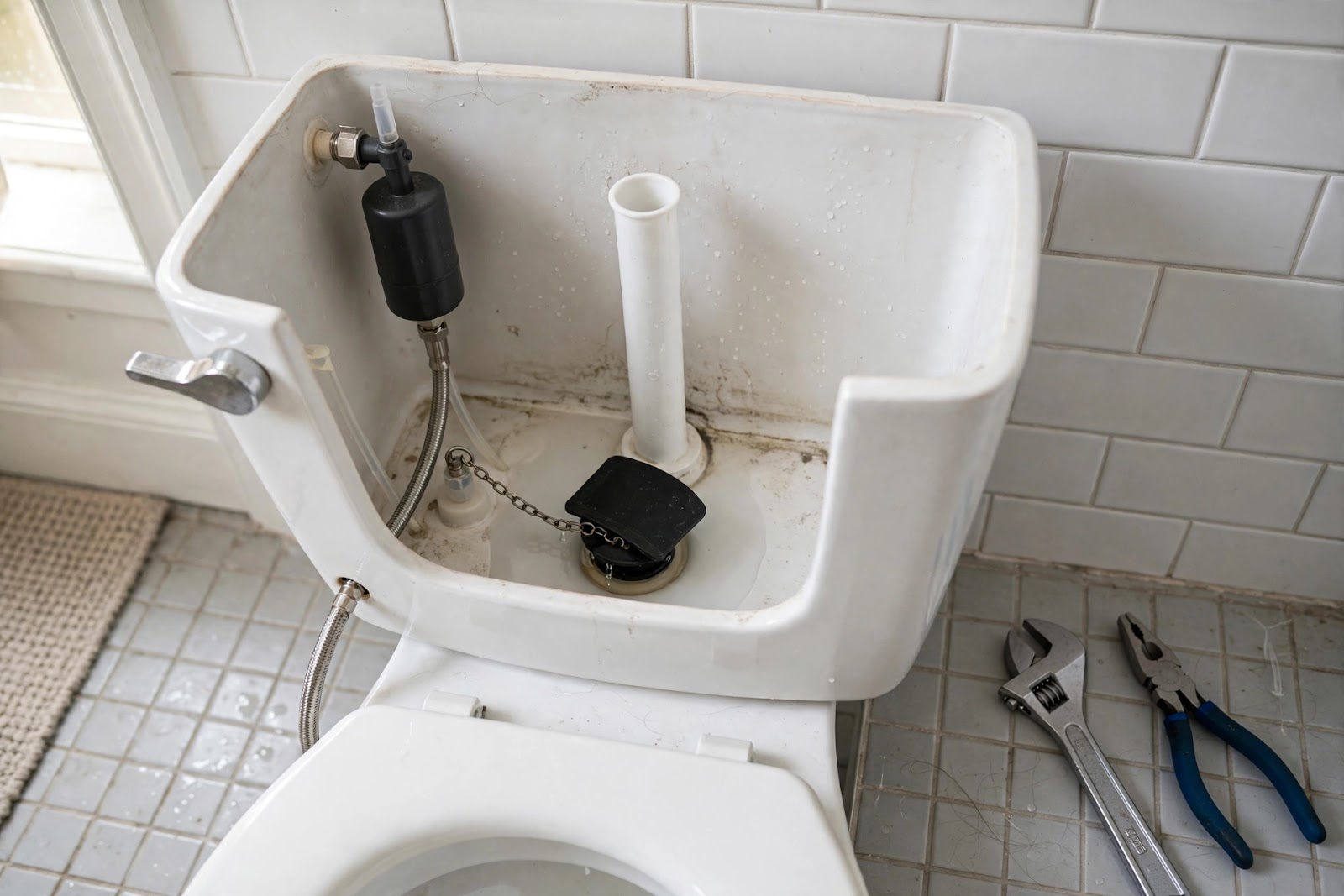
That last one was my problem. The tank would fill, go quiet, and then ten minutes later I'd hear it refilling. That slow drain meant water was leaking from the tank into the bowl, and the only path it could take was past the flapper. A quick way to confirm it is the food-coloring trick: put a few drops of food coloring in the tank water, don't flush, and wait fifteen minutes. If color shows up in the bowl, the flapper is leaking. Mine turned the bowl water a cheerful shade of blue, which was both the diagnosis and a small humiliation, because the fix was so simple.
Swapping a Worn Flapper
Flappers wear out. The rubber gets stiff, warped, or coated in mineral buildup, and then it can't seal flat against the bottom of the tank. Mine was five years old and felt like an old rubber band — stretched out and slightly wavy at the edges. Replacing it is a ten-minute job.
First, turn off the water supply. There's a small valve on the wall or floor behind the toilet, usually with an oval or round handle. Turn it clockwise until it stops, then flush to empty the tank. Keep a towel handy for the bit of water left at the bottom. Safety note worth taking seriously: working with the water on is how you end up with a surprise fountain, and if your shut-off valve is stiff or corroded, don't force it with pliers until it snaps — if it won't budge, that's a good moment to stop and get a plumber involved for that part alone.
The flapper itself is held on by two little pegs on the sides of the overflow tube. Unhook it, take it with you to the hardware store, and match the size — most are two inches, some are three, and guessing wrong means a second trip. I made that second trip the first time, because I was sure I knew the size and I didn't. The new flapper hooks on the same way the old one came off, and you just let it settle flat over the drain hole.
Turn the water back on slowly and watch. My tank filled, the flapper sat flat, and the bowl stayed clear. The two-in-the-morning hissing stopped that night, and I slept better than I had in a week, which is a strange thing to say about a rubber disc that cost me a few dollars.
When the Fill Valve Is the Culprit
Sometimes the flapper is fine and the fill valve is the problem. The signs are different: the tank fills right up to the brim, water trickles down the overflow tube nonstop, and the valve never quite shuts off. Or the valve makes a humming, whistling, or foghorn noise while it fills, which is both annoying and a clue.

The fix here is usually adjusting the water level, not replacing anything. There's a screw or a clip on the fill valve that sets how high the float rides. The water level should sit about an inch below the top of the overflow tube — there's often a fill line marked inside the tank, and your toilet's manual will show the exact spot if yours has one. Lower the float a little, let the tank refill, and check again. I spent an embarrassing twenty minutes once turning the wrong screw before I realized the adjustment clip was on the other side of the valve, so take a second to actually look at how your valve is built before you start twisting things.
If adjusting doesn't help and the valve is old, cracked, or keeps running no matter what, replacing the whole fill valve is still a doable home job. It unscrews from the bottom of the tank, and a universal replacement kit comes with instructions and all the washers you need. Set aside an hour, read the instructions twice, and keep the old parts until the new setup is working — I keep a small box for exactly this, because nothing is worse than throwing away a washer you turn out to need.
The Little Chain That Causes Big Trouble
There's one more culprit that costs nothing to fix: the chain between the flush handle and the flapper. If it's too short, it holds the flapper slightly open all the time, and water leaks through constantly. If it's too long, it can snag under the flapper or tangle, and the flapper won't seat properly. You want about half an inch of slack — enough that the chain hangs in a slight curve, not pulled taut and not draped in a loop.
I check this first now, before anything else, because it's the silliest possible cause and therefore the one I always overlook. A quick hook adjustment on the chain fixed a friend's "broken" toilet in about thirty seconds once, and I still think about how close I came to telling her to buy parts she didn't need.
Knowing When to Stop and Call Someone
Most running toilets are fixed by one of these three things: a chain adjustment, a new flapper, or a fill valve adjustment. But there are limits, and knowing them is part of doing the job well. If the porcelain itself is cracked, if the shut-off valve won't turn or drips when you touch it, or if you've replaced the flapper and adjusted the valve and the toilet still runs, that's the point to call a plumber. You've already done the useful diagnosis, so you can describe the problem clearly, and the visit will be shorter and cheaper for it.
My toilet has been quiet for months now. The whole repair cost me a few dollars and one evening of learning how a tank works, and I still get a small, ridiculous sense of pride every time I flush and hear it fill once, stop, and stay silent. Start with the lid, watch one full cycle, and trust what you see. The tank is simpler than it looks, and most of the time, so is the fix.


