My Bathroom Extractor Fan Hummed But Moved No Air — The Dust-Clogged Impeller I Cleaned in an Hour
I worked out something was wrong with our bathroom fan the way you work out most small household problems: slowly, then all at once. For months the mirror stayed fogged long after a shower. The paint on the ceiling above the shower started to freckle with tiny black spots. I blamed the weather, the shower being too hot, the fact that the window was painted shut years before we moved in. Then one cold morning I held a square of toilet paper up to the fan grille while it was running, and the paper just hung there. Dead still. The fan was humming away happily and moving absolutely no air at all.
That little test took five seconds and told me everything. If your fan sounds busy but a tissue held against it does not even flutter, the problem is almost never the motor. It is the path the air is supposed to take. Something between the grille and the outside world is blocked, and in my case it turned out to be a decade of dust, fluff and damp bathroom air packed onto the fan blades like felt.
I should have looked sooner. I really should have. The fan is one of those square white ceiling units you stop noticing the week after you move in. Ours is a Manrose-style axial fan, the kind fitted in about a million British bathrooms, wired to come on with the light and run on for a few minutes after you switch it off. It had been humming along for years, and I assumed humming meant working. It does not. A fan can hum, spin, vibrate and still shift no air if its blades are choked with crud. That is the first thing nobody tells you about extractor fans: noise is not airflow.
The second thing nobody tells you is how fast a bathroom goes downhill without one. Our bathroom is small, maybe two metres by two and a half, with a shower over the bath and no opening window. Every shower pumps roughly half a litre of water into the air as steam. With the fan working, that steam gets pulled out in ten or fifteen minutes. Without it, the steam condenses on the coldest surfaces it can find: the ceiling, the top of the window frame, the grout lines. Day after day, that damp sits there. The black freckles above our shower were mould, and mould does not need much encouragement. By the time I finally took the fan apart, I had already repainted that patch of ceiling once, with a tin of bathroom paint that cost me fourteen pounds, and watched the spots come back within six weeks. Fourteen pounds and a Saturday afternoon, wasted, because I painted over a ventilation problem instead of fixing it.
Here is what I did, in the order I actually did it, including the bits I got wrong.
The smell test came first, and I do not mean sniffing the fan. I mean standing in the bathroom after a shower and paying attention. The air felt heavy. Towels took a full day to dry instead of a few hours. The mirror stayed cloudy for forty minutes. A working extractor in a bathroom this size should clear a fogged mirror in about ten minutes. Ours was taking four times that, and most of that clearing was just the steam slowly finding its own way out through the gap under the door. If your towels never quite dry and your mirror stays fogged, do the tissue test before you do anything else. Hold a single square of toilet paper flat against the grille while the fan runs. A healthy fan will suck it against the grille and hold it there. A sick one will let it fall, or hold it weakly. Ours did nothing at all, which was at least a clear answer.
Before I touched anything, I turned the power off properly. I know, I know, everyone says that and half of us skip it. Do not skip it on a fan wired into the lighting circuit. I went to the consumer unit and switched off the lighting circuit for the upstairs, then flicked the bathroom light switch on and off to confirm it was dead. I also taped a little note over the consumer unit saying I was working on it, because someone in this house has a habit of helpfully switching things back on. That someone is me, usually, when I forget what I was doing halfway through. The whole job needs a stepladder, a Phillips screwdriver, a small flathead, an old toothbrush, a bowl of warm water with a squirt of washing-up liquid, and a vacuum cleaner with a brush nozzle. Total spend: nothing, because I already owned all of it. If you need to buy the brush and a can of compressed air, budget about eight pounds.
Taking the cover off was the easy part and also the part where I nearly broke something. The square grille on most of these fans is held by a single small screw underneath, or by two spring clips, depending on the model. Mine had one screw, hidden under a little plastic cap I had never noticed. I undid it, the cover dropped into my hand, and underneath was the problem, staring back at me. The grille itself was grey with dust on the inside, and behind it the fan impeller — the little plastic fan wheel — was coated in a thick mat of dust and lint. It looked like someone had wrapped the blades in grey felt. I could barely see the shape of the blades at all.
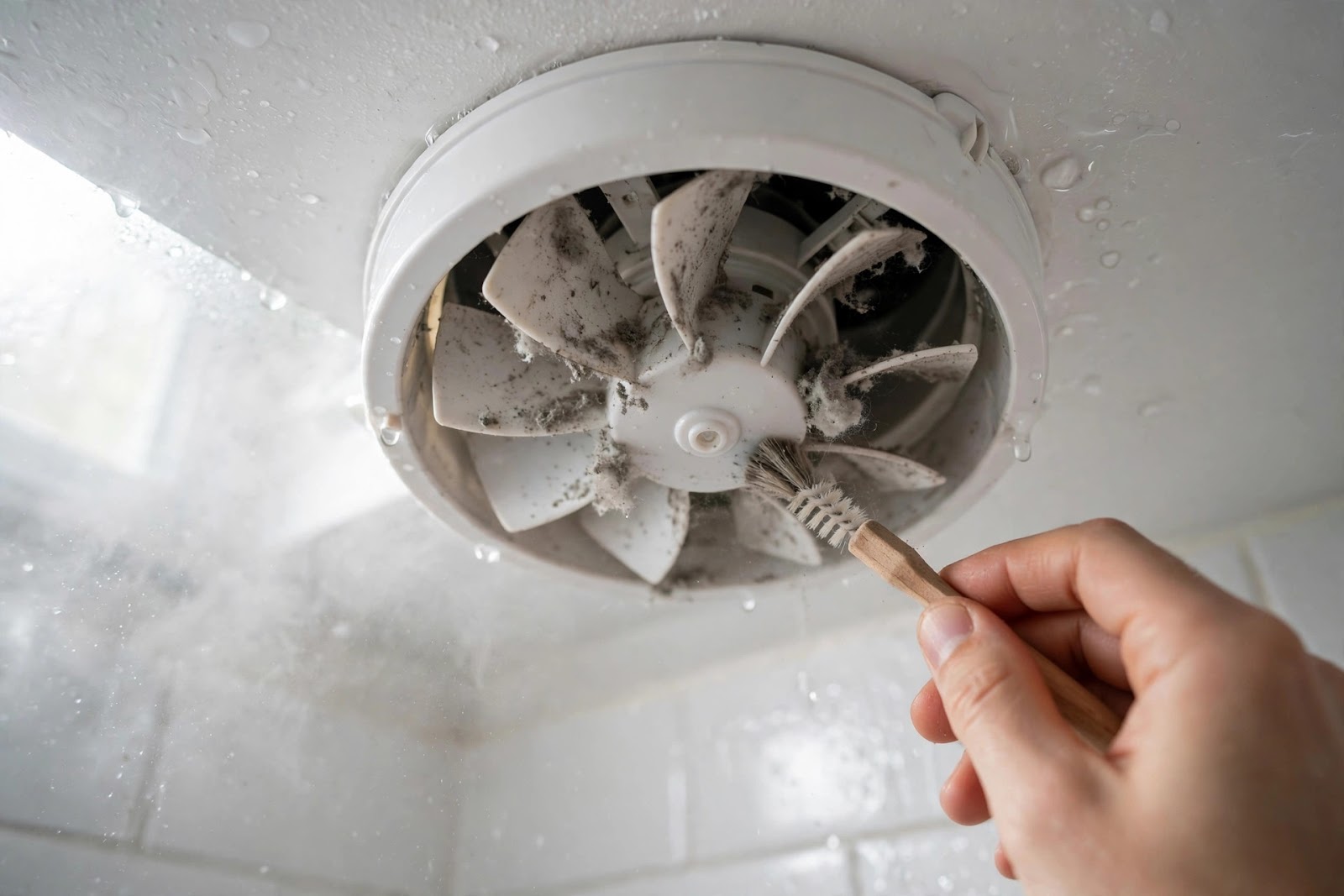
That mat is the whole story, really. Bathroom air is warm and damp, and damp air makes dust stick. Every shower adds a little moisture, every towel shaken out adds a little lint, and the fan sucks all of it straight onto its own blades. Over years it builds up into a layer that changes the shape of the blades. A fan blade works because of its curve. Coat the curve in felt and it stops being a blade and starts being a paddle dragging through the air. The motor still spins — mine was spinning fine — but it cannot grab the air any more. It just churns in place, humming, getting warm, doing nothing useful.
I pulled the impeller off next, and this is where you need to slow down. On many axial fans the impeller just pulls straight off the motor spindle, sometimes with a small circlip or a grub screw holding it. Mine pulled off with a firm tug, but I had spent a minute first taking a photo of how it sat, which way round the blades faced, and where the little locating flat on the spindle lined up. I have learned this the hard way: if a part can go back on two ways, I will pick the wrong one.
The impeller went into the bowl of warm soapy water. I left it to soak for ten minutes while I dealt with the inside of the fan housing. The housing was almost as bad. I ran the vacuum brush nozzle around the inside, then wiped it with a damp cloth. There was a ring of dust around the motor itself, and I brushed that off gently with the old toothbrush, being careful not to push dust into the motor vents. I did not spray anything into the motor. This matters. A friend of mine once blasted his fan motor with a bathroom cleaner spray, thinking he was being thorough, and the fan never ran again. Motors and spray cleaner do not mix. Dry brush, vacuum, damp cloth on the plastic parts only. That is the whole cleaning kit.
While the impeller soaked, I checked the duct. This is the step most people skip, and it is the step that would have caught the second half of my problem. The fan pushes air through a short length of flexible ducting into the loft, and from there out through a vent in the roof or the wall. I went up into the loft with a torch — another job I had been avoiding, because our loft is the kind of place where you find things you forgot you owned — and followed the silver duct from above the bathroom. It sagged in the middle like a hammock, and at the low point there was a puddle of condensation sitting inside it. Worse, where the duct met the roof vent, the jubilee clip had loosened and the duct had slipped half off, so a good chunk of the air the fan did manage to move was just blowing into the loft insulation.
Standing in a cold loft in November, torch in my teeth, pushing a sagging duct back onto a vent, was not my favourite hour of the year. But it explained a lot. Even a clean fan cannot do its job if the duct is kinked, sagging or half disconnected. Air takes the easiest path, and the easiest path was into the loft. I straightened the duct, pulled it taut, and tightened the clip with a screwdriver. I also propped the sagging middle up with a bit of string tied to a rafter, which is not elegant but works — the duct needs a gentle fall toward the outside so condensation runs out, not a dip in the middle where water collects. If your duct runs a long way through a cold loft, wrapping it in a bit of insulation helps too, though I have not done that yet. It is on the list, which is where good intentions go to wait for a free Saturday.
Back in the bathroom, the impeller had soaked clean. I scrubbed the blades gently with the toothbrush, rinsed it, and left it to dry on a towel while I washed the grille in the same bowl. The grille was the worst-looking part, grey and furry, and it came up almost like new after a soak and a scrub. I dried everything properly before it went back. Wet parts and a fan motor are another bad combination, and I had already made enough mistakes for one afternoon.
Reassembly took about five minutes, mostly because I had the photo. Impeller back on the spindle, lined up on the flat, pushed home until it sat where it had been. Cover back on, screw back in. Then I switched the lighting circuit back on at the consumer unit, flicked the bathroom light on, and held my breath. The fan spun up, and the sound was different immediately. Before, it had been a low, laboured hum, the sound of a motor working hard against a load it could not shift. Now it was a higher, freer whirr, the sound of blades actually biting the air.
The tissue test was the moment of truth. I held a square of toilet paper up to the grille and it snapped against it and stayed there, flat and trembling slightly. I actually laughed. It sounds silly, but after months of fogged mirrors and mould spots, watching a piece of toilet paper stick to a fan grille felt like a small victory. I ran a hot shower for ten minutes with the door closed, then watched the mirror. It cleared in about eight minutes. The towels dried by the evening. The little black freckles on the ceiling have not come back, and it has been seven weeks now.
What I got wrong

I would love to say the job went perfectly first time, but it did not. Two things went wrong, and both are worth knowing about before you start. First, I dropped the little cover screw. It bounced off the edge of the bath, rolled under it, and vanished into the gap between the bath panel and the floor. I spent twenty minutes on my stomach with a torch before I found it, and I was lucky — that screw is a specific size, and a trip to the hardware shop for one tiny screw would have been the most annoying errand of the week. Now I put small screws in a jam jar lid or a magnetic parts tray the moment they come out. It sounds fussy. It saves twenty minutes of crawling.
Second, I was too rough with the impeller the first time I tried to pull it off. I yanked it straight toward me without checking for a circlip, and I felt something give that should not have given. It turned out to be fine — the impeller was just stiff on the spindle after years of heat — but I could easily have cracked a blade or bent the spindle. If yours does not come off with a firm, steady pull, stop and look. Some fans have a small clip or a screw on the hub. A minute of looking beats a broken part and a forty-pound replacement fan.
There is one more mistake I made before the job even started, and it cost me that fourteen-pound tin of paint. I treated the symptom instead of the cause. The mould on the ceiling was not a paint problem. It was a ventilation problem wearing a paint costume. If you have mould that keeps coming back in the same spot no matter what you paint over it with, stop painting and start looking at the air. Nine times out of ten in a bathroom, the answer is the fan, the duct, or a window that never gets opened. Fix the air first. Paint second.
When cleaning is not enough
I should be straight about this: cleaning fixed my fan because my fan was dirty. Cleaning will not fix every fan. There are three signs that yours is past cleaning and needs replacing instead. The first is a grinding or scraping noise that does not go away after a clean. That usually means the motor bearings are worn, and no amount of brushing will put them right. The second is a fan that spins slowly even when clean, or one that needs a flick to get going. That points to a tired motor or a failed capacitor, and both mean a new unit. The third is a fan that is simply old and underpowered for the room. Fans are rated in litres per second, and the usual guidance for a bathroom is around fifteen litres per second. If yours is a tiny old unit rated at nine or ten, and your bathroom is big, even a perfectly clean fan will struggle. Check the label on the side of the unit before you decide — mine was rated at fifteen, so cleaning was the right call.
Replacing a like-for-like fan is not a huge job, but it is a step up from cleaning one. You are dealing with mains wiring, even if it is only three wires, and if you are not comfortable with that, this is the job to hand to an electrician. I know my limits. Cleaning, ducting, clips — that is me. Anything where I have to be sure which wire is which while standing on a ladder in a damp room — that is someone qualified. A replacement fan costs anywhere from twenty-five to sixty pounds for a decent one, and an electrician will usually fit it in under an hour. Compare that with the cost of the mould damage a dead fan causes over a year, and it is not a hard decision.
Keeping it working
The part I am actually proudest of is not the fix. It is the fact that I put a reminder in my phone for six months from now: clean the bathroom fan. The whole job, once you know how, takes about an hour, and most of that is the impeller soaking. If you do it every six to twelve months, the dust never gets thick enough to matter, and the fan never gets the chance to quietly give up on you. I also wipe the grille with a damp cloth when I clean the bathroom, which takes thirty seconds and keeps the worst of the dust off. Small habits, honestly. That is all most of home maintenance is: small habits done before things break, instead of big repairs done after.
So here is where I landed. A humming fan is not a working fan. Do the tissue test — it costs nothing and takes five seconds, and it will tell you more than any amount of listening. If the tissue falls, turn the power off, take the cover off, and look at the blades. If they are furred up with dust, clean them. Check the duct while you are at it, because a clean fan pushing air into a sagging, half-disconnected duct is doing the same amount of good as a dirty one. And if cleaning does not fix it, believe the fan. Replace it, or get someone in who can. The mould on my ceiling has not come back in seven weeks, the mirror clears in eight minutes, and the towels dry by evening. All of that for an hour of work and not a penny spent. I wish I had done it the first week the mirror stayed foggy, instead of waiting until the ceiling turned spotty and I had wasted a tin of paint. Do not be me. Go and hold a tissue up to your fan.


