My bedroom window hadn't opened in four years. Not stuck, exactly — I'd never actually tried that hard. It was painted shut, sealed by what must have been three coats of white gloss from three different decades, and I'd got used to it. The room had another window that opened fine. This one was just… a picture of a window. A very clean, very white, very useless picture.
Then we had a week of hot nights in late summer, the kind where the air in the bedroom goes thick by ten o'clock and the fan just pushes warm air around. The good window was on the wrong side of the room for a cross-breeze. The painted-shut one faced the garden, where the evening air was cool. I stood in front of it one night, put both hands on the sash, and pushed. Nothing. Not a millimetre. It didn't even creak. It felt like pushing on a wall.
I'd been putting this off for years because I'd heard the horror stories. Force a painted-shut window and you crack the glass, split the frame, or rip a chunk of wood out of the sash. I'd seen a neighbour do exactly that — one good shove, a crack running corner to corner across the pane, and a glazier's bill that cost more than the window was worth. So I didn't push harder. I went and got a utility knife instead, and gave the job a whole Saturday afternoon, slowly.
It worked. The window opens now, smoothly, every time, and the glass is intact. No new window, no glazier, no damage. Just a sharp blade, a stiff putty knife, patience, and one moment near the end where I nearly ruined it by rushing. Here's the whole job, in the order that worked.
Why forcing it is the worst first move
Paint is stronger than people think. A few coats of gloss paint across the joint between a sash and its frame act like glue, and they're holding the whole edge at once. When you shove the sash, all that force concentrates wherever the paint lets go first — usually one corner — and the sash twists. A wooden sash can take a surprising amount of twisting before it complains, but glass can't. Glass doesn't bend. It cracks, and it cracks suddenly, with no warning creak.
The other risk is the wood itself. Old paint doesn't just sit on the surface. It soaks into the grain at the joint and bonds the two pieces together. Pull hard enough and the paint takes a sliver of wood with it, leaving a ragged edge that will never sit flush again. Then the window rattles forever, or lets in a draught, and you've traded a stuck window for a draughty one. Slow is not just safer here. Slow is the entire method.
So the rule for the whole job is this: cut the paint before you move the wood, and move the wood a millimetre at a time. If something resists, you haven't cut enough paint yet. Never solve resistance with force. Solve it with the knife.
Score the paint seal first, everywhere
The first real step is scoring — cutting through the paint bridge between the sash and the frame, all the way around, on both sides of the window. I used a fresh utility knife blade, and I mean fresh. I snapped off the old tip and extended a new sharp section before I started, because a dull blade tears paint instead of cutting it, and torn paint pulls wood fibres with it. A new blade costs pennies. Use one.
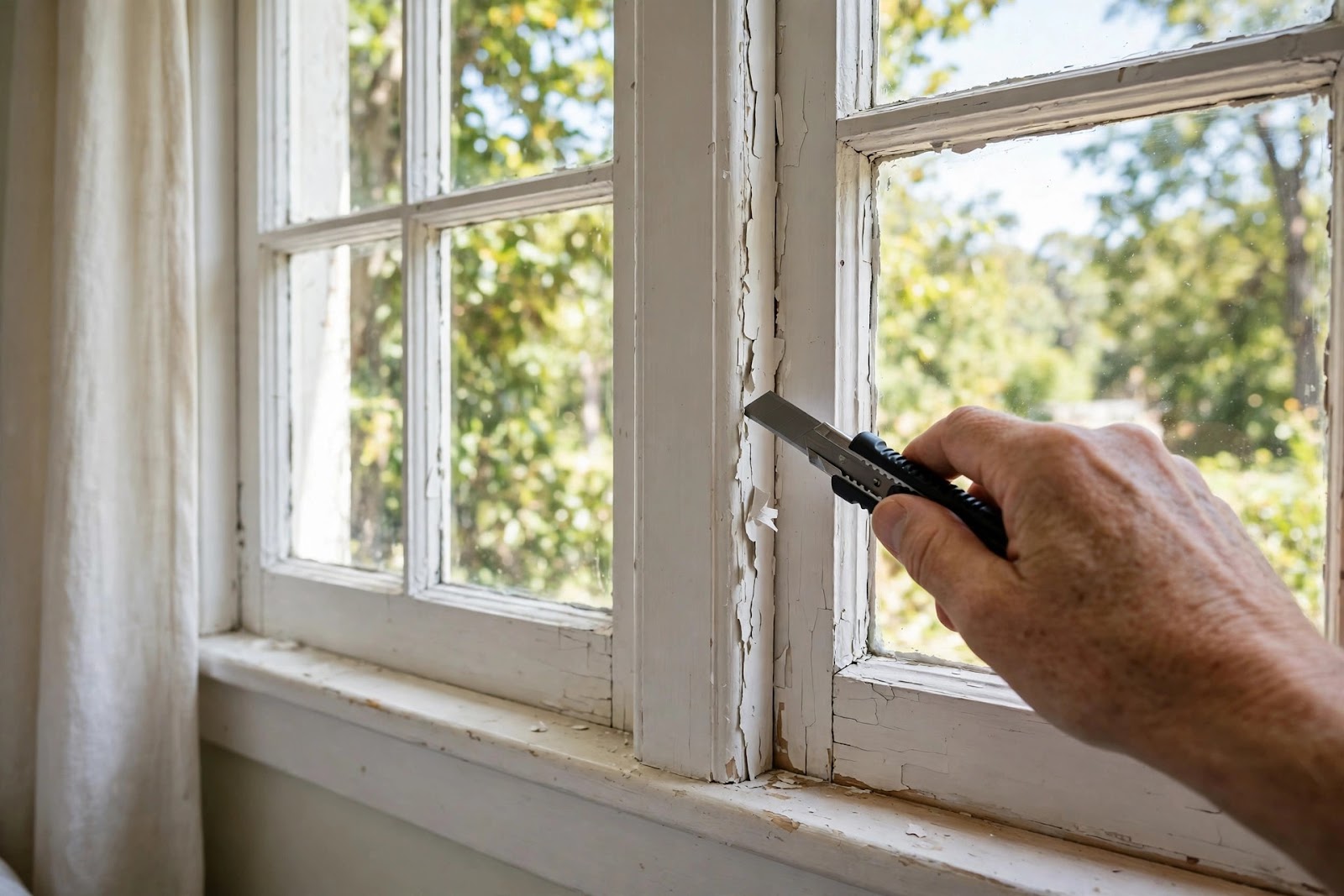
Work the blade along the joint where the sash meets the frame, on the inside of the window first. Hold the knife at a low angle, almost flat against the frame, and draw it along the seam in steady strokes. You're aiming to cut through the paint layers right down to the wood underneath, but not to gouge the wood. Let the sharpness do the work. Pressing harder doesn't cut deeper — it just slips, and a slipping utility knife near glass is a bad combination. Light pressure, several passes, same line every time.
Do all four sides of the sash, inside and out. The outside matters just as much, because paint seals the joint from both faces, and the outside coats are usually thicker — that's the side that got repainted most often. I could only reach the outside of the lower half of my window from inside the room, leaning out carefully, so I did what I could reach and then went outside with a small step ladder for the rest. If your window is upstairs, do the inside thoroughly and get help or a proper ladder for the outside. Don't lean out of a window you're trying to fix.
This scoring took me the best part of forty minutes, and for most of that time nothing looked different. The window still didn't move. That's normal. Scoring isn't supposed to free the window on its own. It just cuts the glue. The freeing comes next, and it only works because the scoring came first.
Working the sash loose, a little at a time
With the paint cut, I took a stiff putty knife — the wide, flat kind, about three inches across — and worked it gently into the scored joint at the bottom of the sash. Not hammered in, not levered hard. Just eased in, a few millimetres, and then wiggled very slightly side to side. The idea is to separate the two painted surfaces that are still lightly stuck together after scoring, without bending anything.
I worked along the bottom edge in short sections, a few inches at a time, easing the knife in and out. Then the sides, bottom to top. Then the top edge, reaching up carefully. After the second pass along the bottom, I felt it — the tiniest give. Not movement, just a change. The sash no longer felt like part of the wall. It felt like a separate piece of wood again, held in place by friction and habit rather than by paint.
That's when I tried the first real push, and here's the trick. Push from the bottom rail, with both hands spread wide, pressing evenly. Never push from one corner. Never push from the middle of the glass. Both hands on the wood of the bottom rail, thumbs on the inside, fingers spread, and push straight out in one smooth motion. Mine moved about two millimetres and stopped. Two millimetres felt like winning the lottery.
From there it was repetition. Score again along the edge that had just moved, work the putty knife in again, push again. Each time the sash moved a little further — five millimetres, then a centimetre, then two. I never pushed harder than I had the first time. The window opened by inches because the paint was cut, not because I was strong. That distinction matters, because the moment you start muscling it, the glass is at risk again.
The moment I nearly cracked the glass
I'm not going to pretend this went perfectly, because it didn't. Halfway through, the top corner of the sash stuck fast while the bottom moved freely. The sash started to twist — bottom out, top in — and I kept pushing the bottom anyway, because the bottom was moving and it felt like progress. It wasn't progress. It was exactly the twisting that cracks glass.
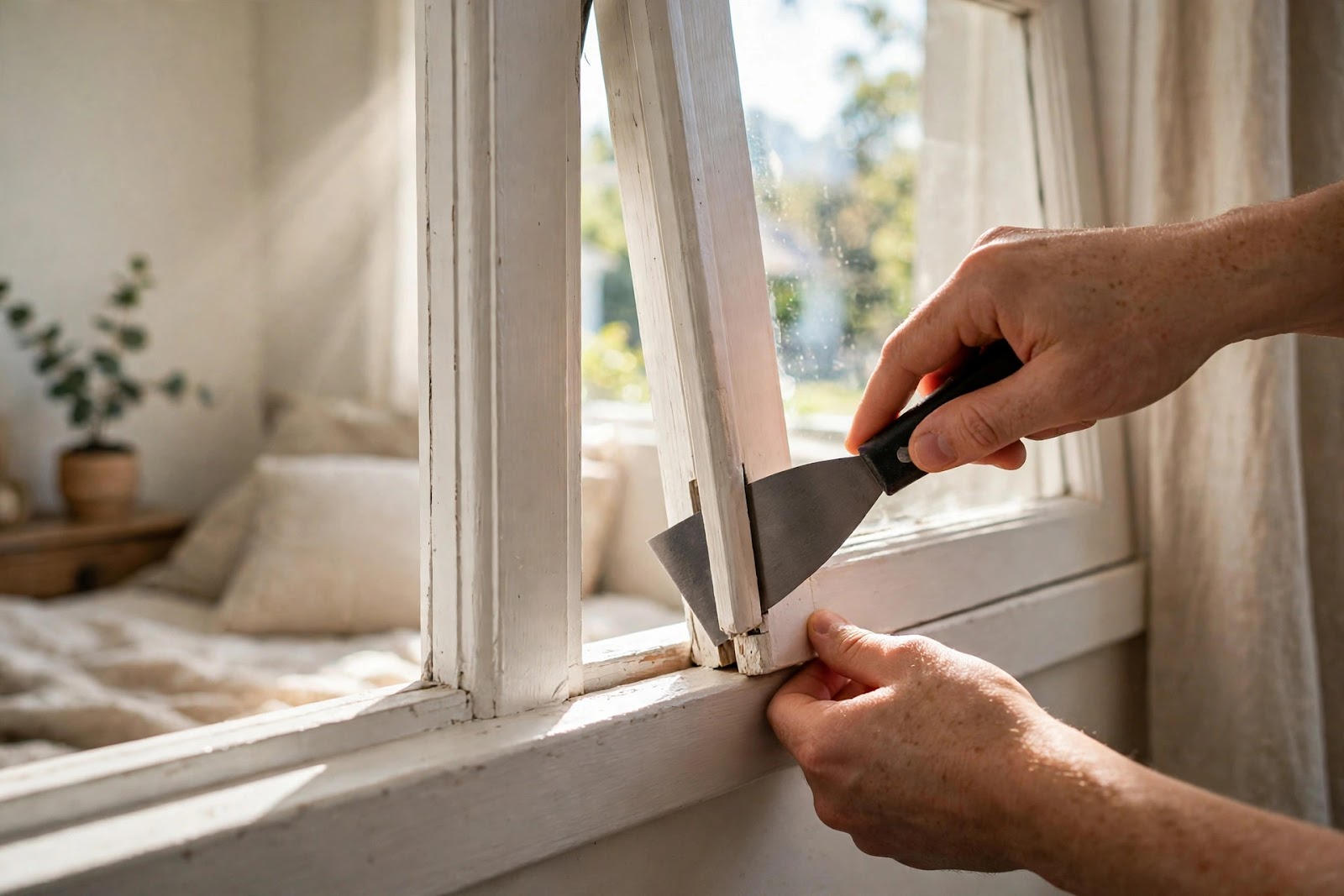
I stopped when I heard a faint ticking sound from the top corner. Not a crack. A tick, like the glass shifting against the putty that holds it. My stomach dropped. I let go, stepped back, and looked at the pane from the side. No crack, thank goodness, but the lesson was right there in front of me: the sash has to move evenly, or not at all. If one corner sticks, you stop pushing and go back to the knife on that corner. Always.
I re-scored the top corner three times, working the blade deeper into the joint, then eased the putty knife in from the top and wiggled it until that corner gave its own small movement. Then I pushed again, both hands, evenly, and the whole sash moved together this time. Slow, level, no twisting. The ticking sound never came back.
If you take one thing from this article, take that. A painted-shut window is a job for even pressure and a sharp blade, not for strength. The second the sash starts moving unevenly, stop. Go back to the knife. The glass will still be there when you're done, and that's the whole point.
Making it open smoothly, and keeping it that way
Once the sash was moving freely, I opened and closed it a dozen times to find the tight spots. There were two: a rough patch on the left side where old paint had built up thick, and a spot at the top where the wood had swollen slightly over the years. For the paint build-up I used a strip of medium sandpaper wrapped around a small block of wood, sanding just the high spot until the sash slid past it without catching. For the swollen wood, a few light passes with the same sandpaper, then a test, then a few more. Take off a little, test, repeat. You can always sand more. You can't sand less.
Then I rubbed a candle stub along all the edges of the sash — the sides, top and bottom. Plain wax, nothing fancy. The wax fills the tiny pores in the wood and lets the sash slide instead of gripping. It's an old trick, and it works absurdly well. A white candle, or even a stub of a tea light, does the job. Rub it on firmly, then open and close the window a few times to spread it. Mine went from stiff to smooth in one pass.
The last step is the one people skip, and it's the reason windows get painted shut again. When you repaint a window, don't paint the sash shut. Leave the window slightly open while the paint dries, and run a knife along the joints before the paint fully hardens. I painted the bare spots I'd sanded with a small brush, left the window open a crack overnight, and scored the joints the next morning while the paint was still slightly soft. It takes five minutes and it means the next person to open that window — probably me, in a few years — won't need a whole Saturday to do it.
That evening the breeze came through the bedroom for the first time in four years, and I sat on the bed just enjoying it, which sounds dramatic for a window but honestly felt like a small victory. The room smelled like the garden. The fan stayed off. And the glass — the glass I'd been so careful with — was still in one piece, which is the part I'm proudest of.
So if you've got a window that's been painted shut for years, don't force it and don't ignore it. Get a fresh utility knife blade, score every joint inside and out, work the sash free a few millimetres at a time with a putty knife, and push evenly with both hands. If one corner sticks, stop and cut more paint. It's a slow afternoon's work, it costs almost nothing, and at the end of it you get your window back — plus the quiet satisfaction of having fixed something the patient way, without breaking anything to do it.


