It was a Tuesday night, and I was making a stir-fry that involved more smoke than I care to admit. The pan was too hot, the oil hit it a second too early, and within about thirty seconds the whole kitchen smelled like a campfire. I reached up, hit the range hood fan on high, and waited for the usual roar.
Nothing much happened. The fan hummed along at what sounded like its normal speed, but the smoke just hung there in a flat grey layer under the ceiling, drifting slowly toward the living room like it owned the place. I waved a tea towel at it, which did absolutely nothing, and then I did what I always do when something in the house stops working properly: I stood there staring at it, hoping the staring would help.
It didn't. And for about a week I convinced myself the fan motor was dying. I even started pricing new hoods in my head, which is a miserable way to spend a Sunday morning. Then one evening, while I was wiping down the stove, I looked up at the underside of the hood and actually saw the filter for the first time. Or rather, I saw what used to be a filter. It was a slab of grey-brown grease with a vague mesh pattern underneath.
The filter I didn't know I was supposed to clean
Here's the embarrassing part: I'd lived in this house for three years and never once taken that filter out. The hood came with the house, and in my head it was just a fan with a light. I knew the light bulb could be changed. I knew the fan had three speeds. The big metal rectangle underneath it? I assumed it was part of the machine, fixed in place, not something a person was meant to touch.
Turns out most range hoods have a grease filter — usually a mesh or baffle type — that slides or pops out in about ten seconds, and it's the single most neglected part of the whole kitchen. Its job is to catch grease before it reaches the fan and the duct. When it's clean, air flows through it easily. When it's coated in three years of frying, it's basically a wall. The fan can spin as fast as it likes; if the air can't get through the filter, nothing gets pulled out of the room.
Mine was a mesh filter, the kind that looks like several layers of fine aluminium screen sandwiched in a frame. It had two little handles and a spring latch on one side. I pressed the latch, the filter dropped about an inch into my waiting hand, and I nearly dropped it from the sheer weight of it. It felt greasy through the paper towel I was holding it with. The mesh had gone from silver to a sticky amber, and in the corners there were actual drips of solidified fat.
Getting it out without dripping grease everywhere
Before you pull yours out, do one thing I didn't do the first time: put an old baking tray or a sheet of newspaper on the stove underneath it. Grease drips. It drips on the burners, it drips on the control knobs, and if your filter is as bad as mine was, it drips on you. I learned that standing directly underneath it in a clean shirt.
Turn the fan and the light off first, and let the stove cool completely — don't do this right after cooking, when the metal is hot and the grease is runny. Then find the latch or the handle. On most mesh filters there's a small spring-loaded tab you push toward the centre; the filter tilts down and slides out toward you. Some baffle filters just lift up and out of a channel. If yours won't budge, check the manual before forcing anything — a previous owner may have wedged it in, or there may be a second clip hiding at the back. Mine came out with a gentle wiggle once I found the tab, and honestly, the hardest part was not flinching at what I found.
While the filter was out, I had a look inside the hood with a torch. The fan blades had a film of grease on them too, and there was a sticky ring around the light cover. Nothing alarming, just the same slow buildup. I wiped the blades down with a damp cloth and a drop of dish soap — the fan was off, and I kept my fingers well away from anything that looked like wiring. The inside of the hood is not a place for a soaking-wet cloth or a spray bottle.

The soak that actually worked
I'd read a few different methods for cleaning a mesh filter, and most of them sounded like more work than they needed to be. Here's the one that worked for me, on the first try, with stuff already under my sink.
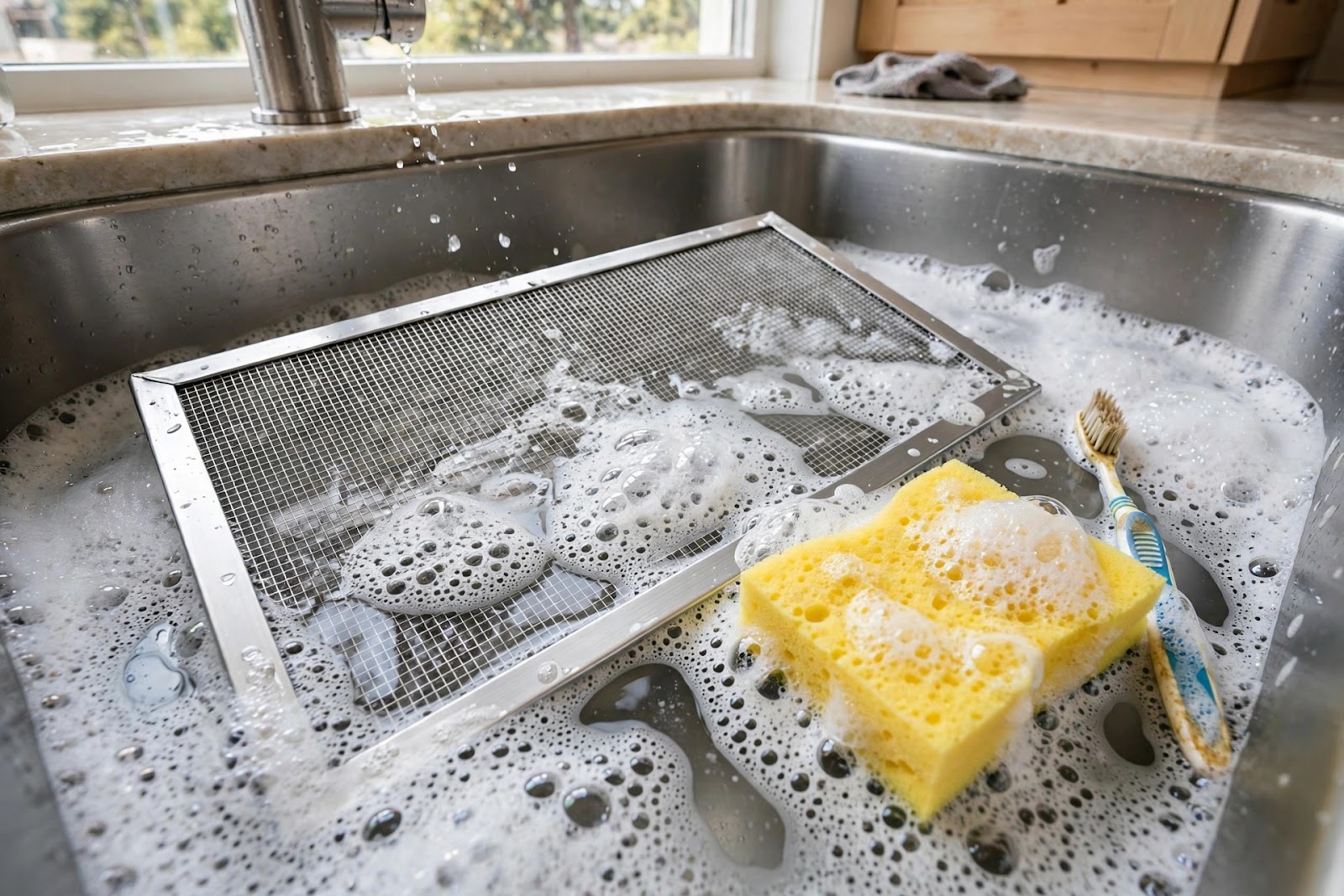
I put the kettle on and filled the sink with the hottest tap water I could stand, then added a good squirt of dish soap and about three tablespoons of baking soda. The filter went in flat, and I poured the kettle water over the top until it was covered. Within about a minute, the water started going cloudy and little beads of grease were floating to the surface. I left it alone for twenty minutes, which was hard, because I kept wanting to poke at it.
After the soak, most of the grease had already let go. What was left came off with an old toothbrush, working in small circles across the mesh. I did both sides, rinsed it under hot running water, and held it up to the light. I could see through the mesh again — actual daylight through the little holes, which felt like a small victory. Then I stood it upright in the dish rack to drip dry. It needs to be properly dry before it goes back, because a damp filter in a warm hood goes musty fast, and the smell will remind you every time you cook.
Two things I did not do, and I wish someone had told me sooner. I did not put it in the dishwasher, because I'd read that the detergent can discolour aluminium mesh and the heat can warp a thin frame — mine was already warped enough from years of heat. And I did not reach for oven cleaner. That's far too aggressive for a filter you'll be breathing through, and the fumes alone aren't worth it. Hot water, dish soap, baking soda, and a bit of patience did the whole job.
What I checked while the filter was out
With the filter drying, I had an excuse to give the rest of the hood a once-over. First, the duct flap — if your hood vents outside, there's usually a little flap or damper where the duct leaves the house, and it can stick shut with grease or get jammed by a leaf or a bit of debris. Mine was fine, but a stuck flap explains a lot of weak hoods, and it's a five-second check.
Second, the light. The cover was filmy with grease, and the bulb underneath was dimmer than it should have been. A quick wipe of the cover made the whole stove brighter, which sounds like a small thing until you try chopping an onion under a dim yellow light.
Third, the fan itself. With the filter out, I switched the fan on for a few seconds and felt the air moving properly through the open slot — strong, steady, no rattling. That told me the motor was fine all along, and the filter had been the whole problem. If your fan rattles or sounds uneven, that's a different job, and it's worth getting someone in rather than guessing.
Putting it back and the test that proved it
Once the filter was dry — I gave it a full hour, propped up on the draining board — it slid back in with a click that was deeply satisfying. The latch caught, the filter sat flush, and the hood looked like it belonged in the kitchen again instead of looking like an exhibit.
Then I did the test. I put a pot of water on to boil, waited for the steam, and switched the fan to medium. The steam went straight up and vanished into the hood instead of spreading across the ceiling. I held a single sheet of kitchen paper up near the filter, and it pulled gently toward the mesh and stayed there. Before the clean, that same sheet wouldn't have moved at all. The next night I made the same stir-fry, and the smoke cleared in under a minute. No tea-towel waving required.
Why it got worse so slowly
The thing about a clogged filter is that it never fails all at once. It just gets a little worse every week, and you adjust without noticing. You leave the fan on a bit longer. You open a window while you cook. You stop frying things quite so hot. I did all three, and I told myself the hood was just getting old — which is the same excuse I use for everything in this house that I don't want to deal with.
That's the real trap with this job. Nothing breaks, nothing smells, nothing makes a noise. The fan still hums, the light still works, and the kitchen just gets a little smokier, a little greasier, month by month. By the time I noticed, the film on top of the cupboards was the giveaway — a thin, sticky layer on the cupboard doors nearest the stove that no amount of wiping would shift, because the grease was in the air, not on the surface. Once the filter was clean, that film stopped coming back.
How often I'll do this now
I've put a note on the inside of the cupboard door next to the stove: filter, first Sunday of the month. A quick rinse in hot soapy water takes ten minutes if you do it monthly, and it never gets a chance to turn into the amber slab I pulled out. If you fry a lot — and I do, more than I should — once a month is about right. If you mostly boil and bake, every two months is plenty.
The filter itself will need replacing eventually. If the mesh is torn, the frame is bent so it doesn't sit flat, or it stays grey and greasy after a proper soak, it's done. A replacement for mine was eighteen dollars, and it took five minutes to fit — same latch, same slot. Just take the old one with you or match the model number, because hoods are not one-size-fits-all, and a filter that's a few millimetres out will rattle forever.
I still laugh at myself for nearly buying a whole new hood because of a dirty filter. Three years of grease, twenty minutes of soaking, and the thing works like the day it was fitted. Check yours this weekend — if you can't remember the last time you cleaned it, it's already overdue, and the fix is probably sitting under your sink right now.


