I found out my oven door was broken the way you find out most kitchen things are broken: dinner went wrong. A tray of roast potatoes came out pale on one side and scorched on the other, and the kitchen was hotter than it should have been with the oven on. I opened the door, closed it again, and watched the top corner. There was a gap, plain as day once I was actually looking for it, about the width of a pencil, with heat shimmering out of it. The door looked shut. It wasn't shut.
I'd been living with it for longer than I want to admit. The oven had started taking longer to preheat, and I'd blamed the heating element, then the thermostat, then my own impatience. But the gap explained all of it in one look: hot air was pouring out of the top of the oven the whole time it was on, the thermostat was chasing a temperature it could never hold, and the side of the tray nearest the gap was cooking in a draft of escaping heat.
The fix was two new hinge springs, a screwdriver, and an afternoon I mostly spent being careful rather than being clever. The oven heats evenly now, it preheats in the time the manual says it should, and the kitchen doesn't feel like a sauna when I roast a chicken. If your oven door hangs open at the top, drops when you let go of it, or your baking has gone uneven for no clear reason, the hinges are the first thing to check.
How I knew it was the hinges and not something else
Before I ordered anything I did a few checks, because oven hinges are not the only thing that can leave a gap. First I looked at the door with the oven cold and the light on in the kitchen, and I could see a line of light between the door and the frame along the top. Then I did the paper test, the same trick as a fridge seal: close the door on a sheet of paper at the top, the sides, and the bottom, and tug. At the bottom it gripped. At the top it slid out without a fight.
Then I opened the door halfway and let go. A healthy oven door stays where you put it, or sinks slowly and smoothly. Mine flopped the rest of the way down like it had given up. That flopping is the classic sign of tired hinge springs. The springs are what hold the door's weight and pull it tight against the seal when it closes. When they weaken, the door sags, the top gaps, and the heat escapes.
One more check worth doing: look at the rubber seal around the oven opening. If it's torn, flattened, or falling out of its channel, that can cause a gap too, and a seal is a cheaper fix than hinges. Mine was intact, just a little dusty, so the hinges took the blame.
Safety first, and I mean it this time
I'm the person who usually skips the safety paragraph and dives in, so let me tell you what made me stop and do this one properly. An oven door is heavy, the hinges are under spring tension, and the glass in the door can shatter if it takes a knock on a hard floor. The first time I took a door off I did it with the oven still warm from lunch, in socks, with nothing soft to put the door down on. I got lucky. Don't be me.
Turn the oven off and let it go completely cold. If it's electric, switch it off at the wall or the breaker, not just on the dial — you don't want it heating up while your hands are in the hinge area. If it's gas, turn the gas off at the supply. Put on a pair of work gloves, lay an old towel or a blanket on the floor in front of the oven, and clear the counter so you have somewhere to set the door down flat.
And keep the kids and the pets out of the kitchen while the door is off — an open oven is a box of sharp edges at exactly toddler height.
Getting the door off without a fight
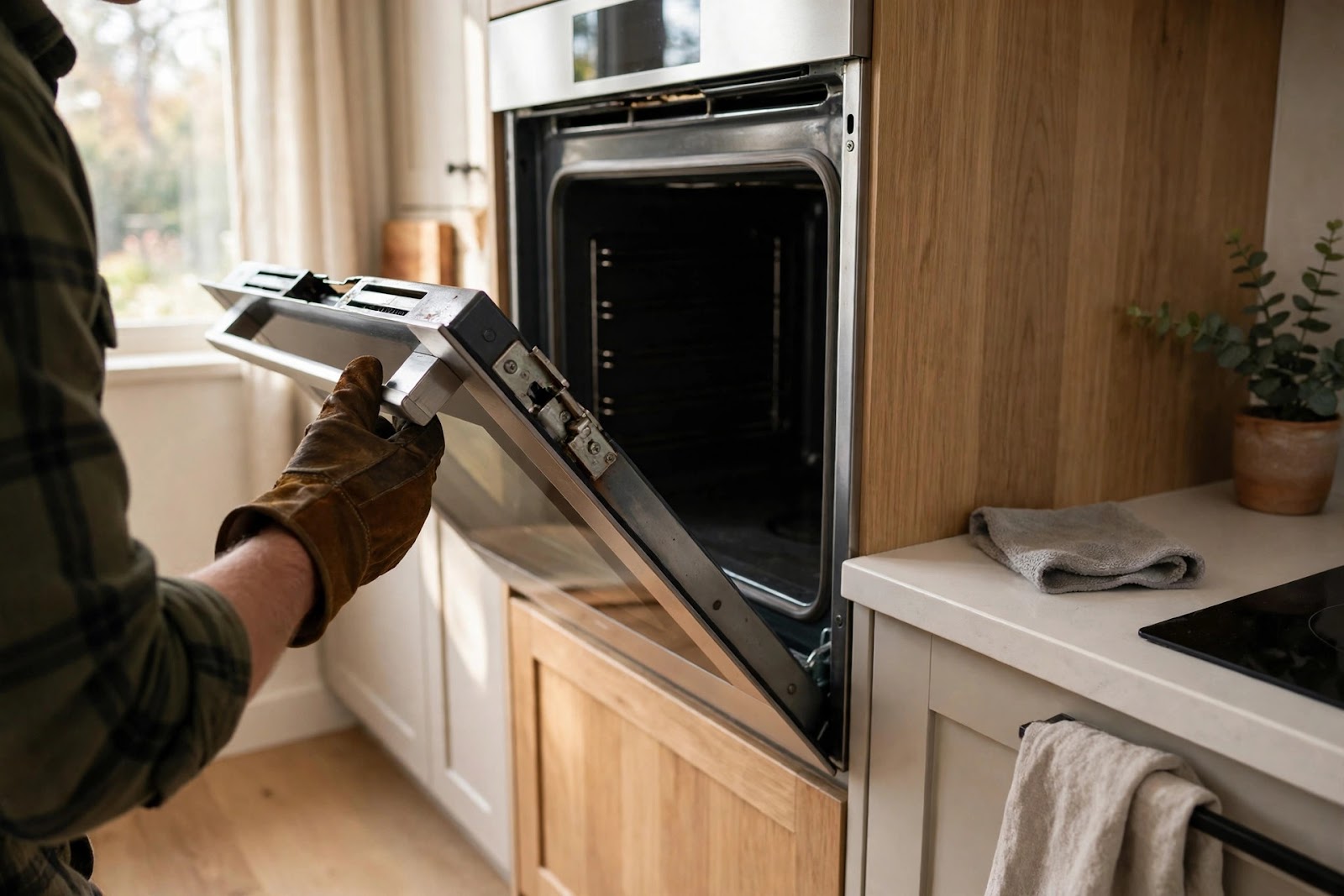
Most oven doors come off the same way, and once you've done it, it feels obvious. Open the door fully, flat, and look at the hinges where they meet the oven frame. On most models there's a small locking tab or lever on each hinge. Flip both tabs up or forward — on mine you lift a little metal catch with a flat screwdriver — and that locks the hinge arm in its open position. This is the step that stops the hinge from snapping shut on your fingers when the door comes off, and it's the step most people skip and regret.
With both hinges locked, lift the door up and toward you at a slight angle. It should come free of its slots with a bit of a wiggle. It will be heavier than you expect, especially if it's a double-glazed door, so hold it with both hands and set it down flat on the towel, outer glass facing down. Don't lean it against a wall or a cabinet. A door leaning at an angle is a door waiting to slide and smash its glass on a tile floor.
If the door won't lift out, stop and check the manual for your exact model. Forcing a stuck door bends the hinge receivers, and then you've turned a hinge job into a frame job.
Swapping the hinges: always do them as a pair
With the door on the towel, the hinges are right there on the sides of the door, usually held by two screws each. I took a photo of each hinge before I touched anything, which turned out to be the smartest move of the afternoon, because the new hinge went on in the exact orientation of the old one and I didn't have to guess.
Undo the screws, lift the old hinge out, and compare it with the new one before you fit anything. The part number is stamped on the hinge arm, and you order by the oven's model number, not by what the hinge looks like. I learned this the expensive way years ago on a different appliance, ordering a part that looked identical and wasn't. Two hinges for my oven cost me just under forty dollars, and they arrived in three days.
Replace both hinges even if only one looks bad. They've both done the same number of openings, and the second one is as tired as the first. Fitting a single new hinge next to a worn one leaves the door pulling unevenly, and you'll be doing the job again in six months. Fit the new hinges in, screws snug but not cranked down so hard you strip the threads, and double-check they sit flush against the door frame of the door itself.
One fiddly detail: on some doors the hinge is held by a spring clip inside the door, and the hinge arm needs to be in its locked-open position to come out. If yours won't budge, flip the locking tab first and try again. And keep the screws somewhere safe. I put mine in a small bowl on the counter, because screws dropped behind an oven are gone forever, and I have the missing screws to prove it.
Putting it back and proving it worked

Refitting the door is the reverse of removing it: hold it at a slight angle, slide the hinge arms into their slots in the oven frame, lower the door until it seats, then flip the locking tabs back down. Close the door slowly and watch the top edge. On mine the gap was gone immediately, and the door closed with a solid little thump instead of the soft, tired sigh it had been making.
Run the paper test again. Top, sides, bottom — the paper should grip everywhere now. Then preheat the oven empty to 200 degrees and time it. Mine hit temperature in twelve minutes, where before it had been taking nearly twenty and the kitchen was warming up with it. Stand next to it while it heats and feel around the door edges with the back of your hand. You should feel warmth, not a stream of hot air.
The real proof came the next evening with a tray of roast vegetables: even browning, all the way across, for the first time in months. I'd been blaming my recipes and my oven's thermostat for something that was a pair of worn springs all along.
When new hinges won't fix it
Sometimes the hinges are fine and the problem is somewhere else. If the door still gaps after new hinges, check the hinge receivers — the slots in the oven frame the hinge arms slide into. If they're bent or worn wide, the arms won't seat properly no matter how new the hinges are. That's a bigger job, and it's the point where I'd call a repairer rather than keep going, because the receivers are part of the oven's body.
A bent door is the other one. If the door itself has a bow in it, from someone standing on it while it was open or from a heavy tray dropped on it, new hinges will pull the sides tight and the middle will still gap. Lay a straight edge along the door to check. And if the seal around the opening is flattened or torn, replace that too — it's a separate part, it usually just pulls out of its channel and pushes back in, and a new seal with new hinges together is the combination that actually makes an oven airtight again.
Also worth saying: if your oven is gas and you're not comfortable working around it, or if anything about the job feels wrong once the door is off, stop and call someone. A pair of hinges is a cheap repair, but a gas supply and a heavy glass door are not the place to improvise.
What I do differently now
I don't yank the oven door open by the handle anymore, and I never let it drop from halfway — that flopping open is what wears the springs out in the first place. I give the seal a wipe when I clean the oven, and I do the paper test once a year, usually when I do the smoke alarm batteries, because that's the one household job I actually remember on schedule.
The funny thing is, the whole repair cost less than one takeaway dinner, and it fixed a problem I'd been working around for months without naming it. Uneven baking, slow preheating, a hot kitchen, a rising bill — all of it traced back to two tired springs and a gap I could have spotted with a sheet of paper. If your oven door drops when you let go of it, or your baking has gone lopsided for no good reason, check the hinges before you blame the recipe. Your oven might just need a little spring back in its step.


