The first time I heard it, I thought someone was knocking on the back door at 2 a.m. A single hard thunk from inside the wall, loud enough to wake me, then silence. I lay there listening, heart going, and nothing else happened. The next night it came again, twice, right after the washing machine finished filling. That was the clue I almost missed: the noise only ever happened when water stopped moving, not when it started.
What I had was water hammer. It sounds dramatic because it is dramatic, in a small way. When a valve shuts fast, a column of water that was rushing through the pipe has nowhere to go, so it slams into the closed valve and the shockwave rattles back down the pipe. Old plumbers call it hydraulic shock, which sounds like something from a physics exam, but all it means is that moving water is heavy and it does not like stopping suddenly. A washing machine solenoid valve snaps shut in a fraction of a second, which is why the washer was my trigger. Dishwashers do it too, and so do some fast-closing taps.
I ignored it for about three weeks, which was stupid. A single bang is annoying. A hundred bangs a month is a slow beating on every joint, elbow, and fitting in your system. Water hammer can loosen pipe straps, crack soldered joints, and in a bad case split a fitting behind a wall where you will not see the leak until the plaster goes soft. I found that out the worrying way, reading about it at midnight instead of sleeping, and the next morning I got on with fixing it.
Finding the bang before fixing it
The first job is figuring out where the noise actually lives. Mine sounded like it came from the kitchen wall, but water hammer is a ventriloquist: the shockwave travels, so the bang can sound ten feet from the valve that caused it. I worked through it methodically, which took one evening and cost nothing.
I started by turning off every tap and appliance, then turning them on one at a time and shutting each one off sharply. The kitchen tap, closed fast, gave a dull knock. The washing machine gave the full haunted-house thunk. The dishwasher gave a softer version of the same. So the washer was the worst offender, but the system as a whole was jumpy, which told me the problem was not just one valve. It was the system.
Next I checked the water pressure, because high pressure makes hammer worse. I borrowed a pressure gauge that screws onto a garden tap from a neighbour, and it read just over 80 psi. Anything above 80 is too high for a house, and mine was sitting right on the line. If you do not have a gauge, your local hardware store sells one for a few dollars, and it is the kind of tool you will use twice a decade and lend to everyone you know.
Then I looked at the pipes themselves. In the basement, a run of copper pipe along the joists had straps spaced so far apart that I could move the pipe up and down with one finger. Loose pipes do not cause hammer, but they make it ten times louder, because the pipe itself whips when the shockwave hits. Tightening those straps was the cheapest part of the whole fix and made the biggest immediate difference to the noise.
The strap fix first, because it is free
Before spending a cent, I went around the accessible pipework with a screwdriver and a handful of pipe clips. Every strap that had worked loose got tightened. Where a strap was missing entirely, I added a plastic pipe clip, screwed into the joist, with a little slack left in it. Here is the part people get wrong: do not clamp copper tight against wood. Copper expands and contracts with hot water, and a rigid clamp turns into a creak every time the heating runs. Leave a millimetre or two of play, and if the pipe touches a joist, slip a bit of felt or rubber between them. I used offcuts of an old foam pipe sleeve, which worked fine.
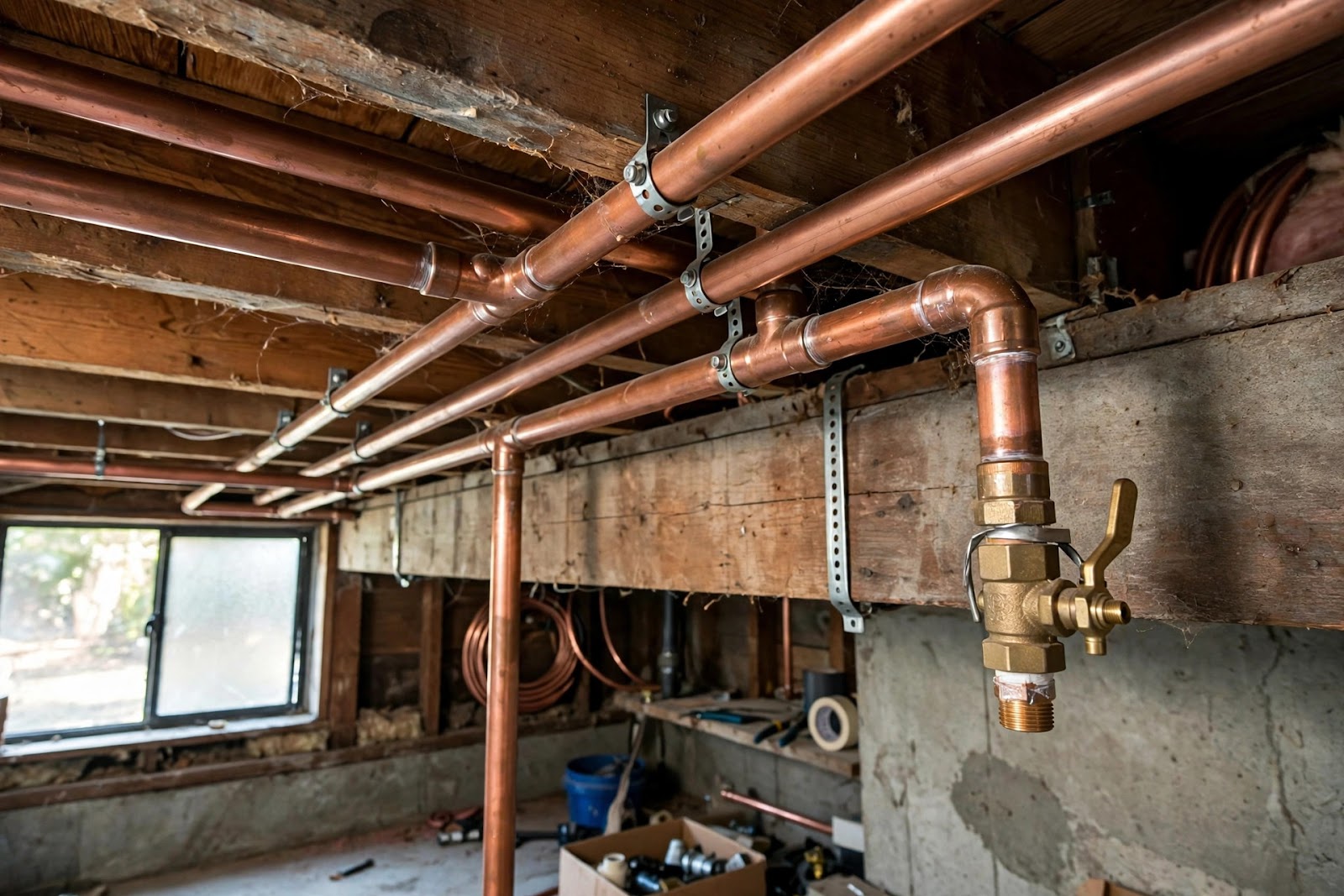
That alone cut the noise by more than half. The bang was still there when the washer valve snapped shut, but it had gone from a door-slam to a firm knock. Encouraging, but not fixed. The shockwave was still travelling through the system, and I knew from the pressure reading that I had a second problem to deal with.
Air chambers, and why mine had died
Older houses often have air chambers, which are just short vertical stubs of pipe, capped at the top, fitted near taps and appliances. The trapped air in them acts like a cushion, compressing when the shockwave hits. They work beautifully until the air dissolves into the water over months and years, at which point they become solid stubs of water that do nothing at all. Mine were waterlogged, which is the normal state of a twenty-year-old air chamber.
You can recharge them, and the method is simple enough that I felt silly for not knowing it. Turn off the water at the main shutoff. Open the highest tap in the house and the lowest one, and let the system drain down until the taps run dry. Leave them open for ten or fifteen minutes so the air chambers drain out too. Then close the taps, turn the water back on slowly, and the chambers refill with air trapped at the top. It cost me nothing but half an hour, and for two days the banging stopped completely.
Two days. Then it crept back, because the air dissolves again, and it always will. Recharging air chambers is a useful diagnostic, though. It proved the shock was real hammer and not a loose pipe pretending to be one, and it bought me a quiet weekend while I ordered the proper fix.
The proper fix: a water hammer arrestor
A water hammer arrestor is a small sealed cylinder with a piston and a pocket of pressurised air inside, and it does permanently what an air chamber does temporarily. It screws or solders into the pipe near the offending valve, and when the shockwave arrives, the piston compresses and absorbs it. They cost around ten to fifteen dollars each, and they come in sizes matched to the pipe: half-inch for most household supply lines, three-quarter for a main run.
I fitted one on the washing machine supply, which was the worst offender, and one on the dishwasher line. Fitting them was a Saturday morning job. I shut off the water, drained the lines, cut a short section of the copper feed pipe with a pipe cutter, and soldered in a tee with the arrestor pointing straight up. Straight up matters: the arrestor has to sit vertical so the air pocket stays at the top. If you are not comfortable soldering, push-fit tee fittings exist that do the same job with no flame, and for a washing machine you can even buy a screw-on arrestor that goes straight onto the tap outlet behind the machine, no cutting at all. That screw-on version is honestly the one I would recommend to a first-timer.
One warning from my own afternoon: measure the space behind the washing machine before you buy. My first arrestor was too tall for the gap between the tap and the wall, and I only discovered that with the machine pulled out and the water off. I swapped it for a shorter screw-on model and the whole thing took twenty minutes. Measure twice, buy once, and all that.

The pressure problem I almost skipped
With the arrestors in, the banging was gone, but I still had that 80 psi reading nagging at me. High pressure does not just feed hammer; it shortens the life of tap washers, toilet fill valves, and appliance solenoids. The washing machine valve that snapped shut so violently was partly doing it because the pressure behind it was too high.
I found the pressure-reducing valve on the main line where it enters the house, a bell-shaped brass fitting I had walked past for years without noticing. It had an adjustment bolt on top. Turning it anticlockwise a quarter turn at a time, then checking the gauge, brought the pressure down to 60 psi, which sits comfortably in the 50 to 70 range most houses want. If your house has no pressure-reducing valve at all, a plumber can fit one, and it is worth it: it protects everything downstream, not just the hammer.
A quick word of caution here. If your pressure is over 80 and you have never had a reducing valve, do not just crank an existing one down hard in one go. Adjust in small steps and check the gauge each time. And if the valve is seized solid, leave it alone and call someone. A snapped adjustment bolt on a main line is a very wet afternoon.
What it cost, and what I would do differently
The whole job came to about thirty dollars: two arrestors, a handful of pipe clips, a tee and some solder I already had. The pressure gauge was borrowed. The quiet was worth far more than that, and so was the knowledge that the joints behind my walls were no longer taking a beating every time the washer filled.
If I did it again, I would start with the pressure check. I spent a week chasing the noise around the house when the gauge reading would have told me in five minutes that the system was running hot. I would also fit the arrestors before recharging the air chambers, because the recharge was a red herring that made me think the job was done when it was not. Still, I learned something from every wrong turn, which is the only honest way most of us learn anything about our houses.
One last thing. There is a version of this noise that no arrestor will fix: a bang that happens when no tap or appliance is running, or a bang that comes with a drop in pressure or a damp patch on a wall. That is not water hammer. That is a leak, or a failing valve, and it needs a plumber, not a Saturday project. Know the difference, and do not let a confident blog post talk you out of calling one.
The washer runs four loads a week in my house, and the walls have been silent through every one of them for three months now. That is the whole payoff: a house that stopped knocking in the night, fixed with thirty dollars and one Saturday, and a pressure gauge I still owe my neighbour.


