My bed frame squeaked. Not a little creak now and then — a full, theatrical groan every single time I rolled over, sat down, or even thought about getting comfortable. For months I slept through it, or tried to. I'd lie there at 3 a.m., wide awake, listening to the frame complain underneath me like it was filing a formal protest about my weight.
I blamed the mattress first. That's what everyone does. I spent a week convinced the springs were going, turning the mattress over, rotating it, pressing down on different corners like some kind of mattress detective. The mattress was innocent. Then I blamed the floor. Maybe a floorboard under the bed leg. I even shoved a folded towel under one leg, which did nothing except make the bed sit crooked.
The real culprit, when I finally found it, was embarrassingly simple: the bolts holding the side rails to the headboard had worked loose over the years, and bare wood was rubbing on bare wood every time the frame moved. Two bolts, a bit of felt, and half an hour fixed a problem I'd been losing sleep over for months. I wish I'd looked underneath the bed on day one.
Finding the squeak (it's a two-person job, sort of)
The trick is to find the exact spot before you fix anything, because a bed frame has a lot of joints and they all sound the same from above. Take the mattress and the bedding off first. Yes, it's a faff. Do it anyway — you can't diagnose a frame you can't see, and you'll be lying on the slats pressing things anyway.
Then get someone to rock the frame gently from side to side while you crouch down and listen with your ear close to each joint in turn. If you live alone, you can do it yourself: push the headboard sideways with one hand and hold your other hand on each joint, feeling for the vibration. The squeaky joint is the one you can feel buzzing under your palm. On mine it was the top bolt on the left side rail, where it meets the headboard. The right side was starting to go the same way, just quieter.
Check every joint, not just the loudest one. Bed frames loosen in pairs — if one side has worked loose, the other side has been taking extra strain and it's usually not far behind. I fixed the left side first, put the mattress back on, and lay down proudly to enjoy the silence. Then I rolled over and the right side squeaked. So the mattress came off again. Learn from me: do all four corners in one go.
While you're down there, check the slats too. Lift each one and look at the ends. A slat that's cracked, or one that's slipped off its little support ledge, will creak in a different way — more of a sharp crack than a groan. And check the centre support leg if your bed has one. Mine has a leg in the middle of the frame that had sunk a few millimetres into the carpet, which meant the whole frame was flexing slightly every time I moved. A little felt pad under that leg sorted it.
What worked, in order
The fix has three parts, and they go in this order: tighten, cushion, then test. Skipping the middle step is why so many bolt-tightening fixes only last a month — you tighten the bolt, the wood settles, the bolt loosens a fraction, and the rubbing starts again.
Start by taking the bolt out completely, one joint at a time. Don't undo all four corners at once or the whole frame will collapse into a pile of timber on your bedroom floor. One joint, fix it, move to the next. Undo the bolt and the barrel nut — that's the little cylinder inside the rail that the bolt screws into — and have a proper look at both.
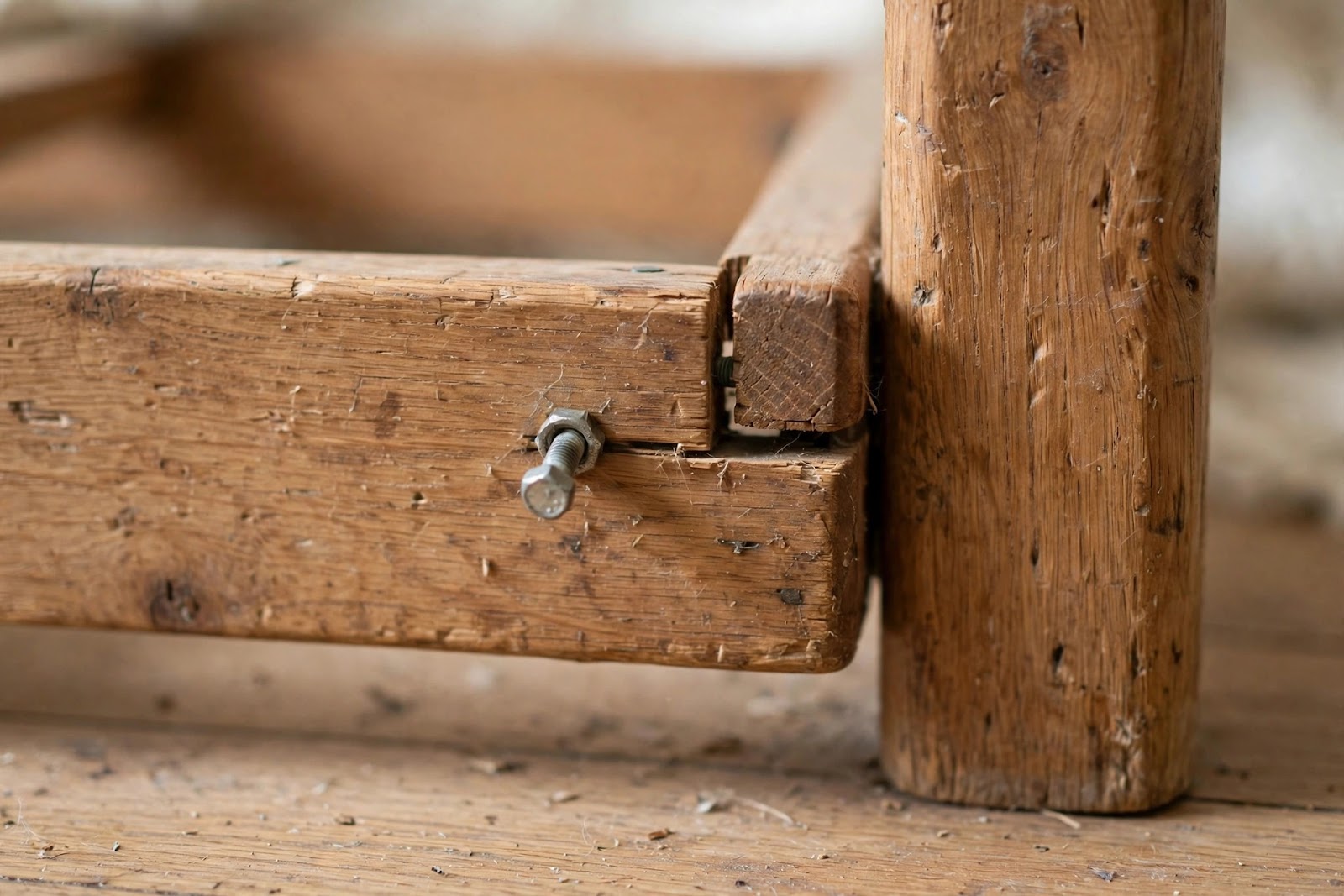
On mine, the barrel nut had worn a slightly oval hole in the wood from years of movement, which meant the bolt could never quite pull tight. The hole was a fraction too big, so the bolt had room to wobble. This is the bit most people miss. If you just screw the same bolt back into the same worn hole, you're resetting the clock, not fixing the problem.
The repair for a worn bolt hole is gloriously low-tech: wooden matchsticks, or cocktail sticks, and a bit of wood glue. Dip a few sticks in glue, push them into the hole until it's packed snug, snap off the ends flush, and let the glue dry for an hour. Then drill a small pilot hole — smaller than the bolt — and screw the bolt back in. The bolt now bites into fresh wood instead of a worn-out hole, and it stays tight. I've used this matchstick trick on door hinges and chair joints too. It feels like cheating. It works every single time.
The felt pad trick that actually keeps it quiet
Here's the part that makes the fix last. Before you bolt the joint back together, stick a small piece of self-adhesive felt — the kind sold as furniture pads — onto the face of the rail where it meets the headboard. Just one pad, trimmed to fit, right where the two pieces of wood touch. When you tighten the bolt, the felt compresses into a thin cushion between the two surfaces.
Why does this matter? Because the squeak isn't really the bolt. The squeak is two pieces of bare wood rubbing against each other when the frame flexes. The bolt just holds them close enough to rub. The felt puts a soft layer between them, so even when the frame moves a fraction, there's nothing hard rubbing on anything hard. No friction, no noise.
I used the thin felt pads, about 2mm thick, not the thick woolly ones — thick pads stop the joint pulling tight and the whole thing ends up wobbly. Trim the pad so it doesn't stick out past the edge of the wood, or you'll see a little grey line at the joint and it will look unfinished. A craft knife and thirty seconds does it.
If you don't have felt pads, a thin strip of cork, a piece of an old leather belt, or even a folded bit of fabric will do the same job. The material matters less than the idea: something soft between two hard surfaces. But felt pads cost almost nothing and they're already adhesive, so they're the easy choice.
Don't forget the slats
While the mattress is off, sort the slats. They cause a surprising number of bed noises, and they get blamed on the frame all the time. Lift each slat and check it sits flat on both support ledges. If a slat rocks, it's either warped or the wrong way up — flip it over and try again. Some slats are slightly bowed on purpose and they only work one way up, with the bow facing the ceiling.
If a slat slides around, a small screw through the end into the support ledge pins it in place. One screw per slat, at alternate ends, is plenty. Don't screw every slat at both ends — wood needs a little room to move with the seasons, and pinning everything solid is how you get a cracked slat in winter.
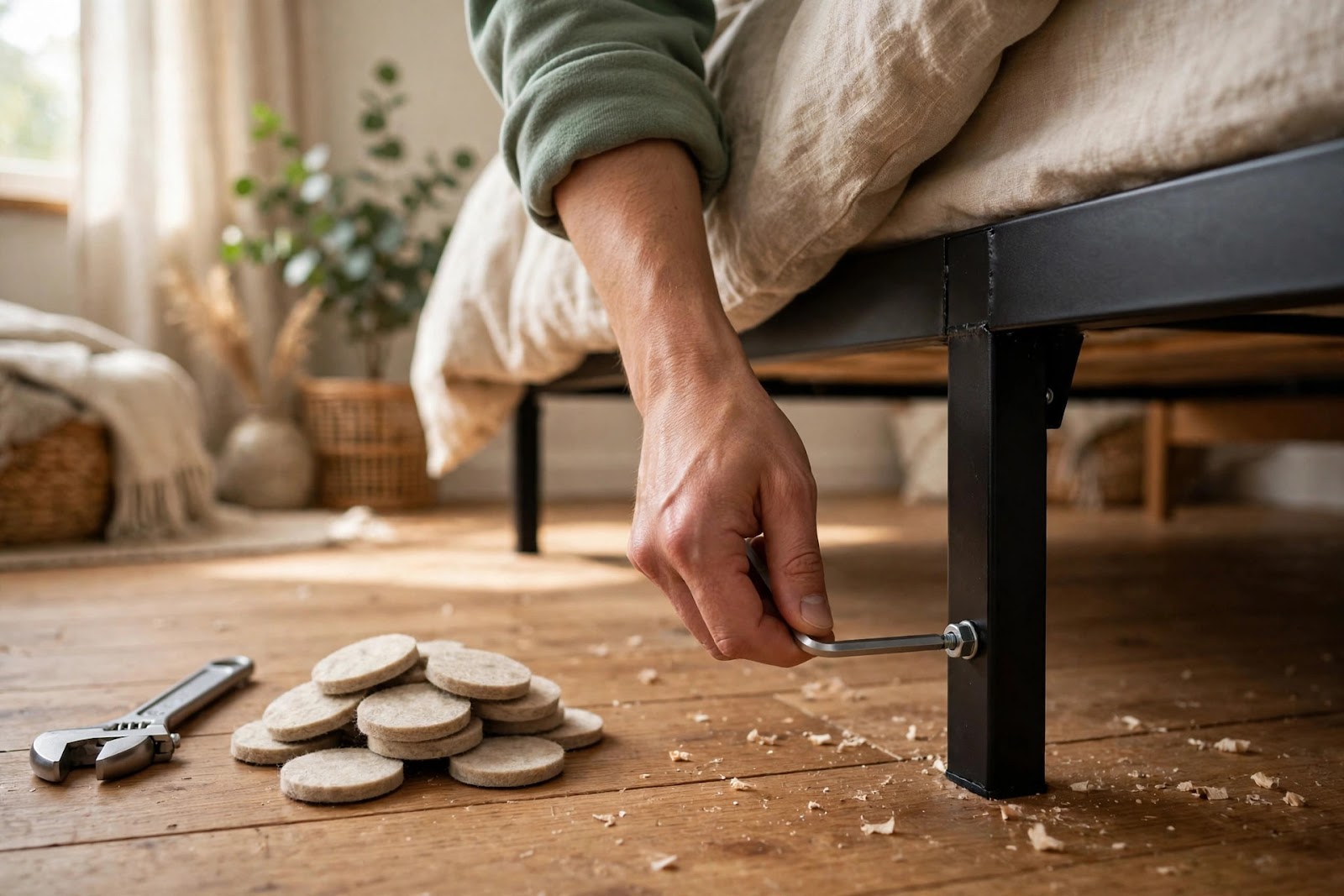
A strip of felt along the top of the support ledge helps too. Same idea as the joints: wood on wood makes noise, wood on felt doesn't. I ran a strip of self-adhesive felt tape along both ledges, laid the slats back down, and the whole bed went from a creaky orchestra to something approaching silent.
The mistake I made first
Before I found the real fix, I tried the internet's favourite answer: WD-40. I sprayed it into every joint I could reach, feeling very clever. The squeak stopped for about two days. Then it came back louder, because the oil had soaked into the wood around the bolt holes and softened the fibres, so the bolts worked loose even faster. Oil on a wooden bed frame is a short holiday for the squeak, not a cure — and it stains the wood and smells for a week.
I also tried just tightening the bolts without taking anything apart. That lasted about three weeks. The worn hole was still worn, the wood was still rubbing on wood, and the bolt just worked loose again. Tightening is part of the fix, not the whole fix. The matchsticks and the felt are what make it stick.
The test that tells you it's done
Put the mattress back on, but before you make the bed, do the test properly. Lie down and roll from side to side, slowly, then sit up sharply, then bounce a little. Do it at every corner of the bed, not just the middle. Then get up, walk around the bed, and push the frame sideways from the foot end. Silence? Good. A faint creak from one corner? That's the joint you need to go back to.
Then sleep on it — literally. A bed can pass the daytime test and still talk at 3 a.m., because that's when you move in your sleep and the frame takes your full weight in odd positions. Give it a week. If it's still quiet after seven nights, you've actually fixed it, and you can stop listening for it every time you roll over.
Mine has been quiet for eight months now. Eight months of not waking myself up every time I turn over, which turns out to be a bigger quality-of-life improvement than I expected. I sleep better, which means I'm less grumpy in the morning, which my whole household appreciates.
So if your bed frame is keeping you awake, don't buy a new mattress and don't buy a new bed. Take the mattress off, find the joint that's actually moving, pack the worn hole with matchsticks and glue, put a felt pad between the wood faces, tighten it up, and check the slats while you're there. It's a Saturday morning job, it costs less than a takeaway, and you get your sleep back. That's a trade I'll take every time.


