The Plates Kept Sliding Into a Dip in the Cupboard — A Wooden Batten Underneath Sorted It
I first noticed the dip in our kitchen cupboard shelf the way you notice most slow household failures: a plate slid. Not dramatically. I had stacked the dinner plates the way I always do, in a neat pile on the middle shelf, and when I reached for one the whole stack had drifted an inch toward the centre. The plates were leaning, gently, like a tiny tower of Pisa made of crockery. I pushed them back. Two days later they had drifted again. That was when I actually looked at the shelf properly, and saw it: a shallow, unmistakable sag in the middle, maybe fifteen millimetres deep, like a hammock strung between the two sides of the cupboard.
Fifteen millimetres does not sound like much. On a shelf it is everything. Plates slide. Bowls nest at an angle. A stack of heavy stoneware leans until the top plate catches the shelf above and chips. I had already chipped two plates before I admitted the shelf was the problem and not my stacking. The worst part was that I had been looking at this cupboard every day for years and never seen it, because a sag develops so slowly that your eye adjusts to it. It is only when something starts sliding that you realise the surface you trusted was never flat at all.
Our kitchen cupboards are the flat-pack kind, fitted by the previous owners, with shelves made of chipboard covered in a thin white melamine skin. The shelf in question is about eighty centimetres wide, eighteen millimetres thick, and it holds the everyday plates, bowls and mugs — the heavy stuff, the things you reach for three times a day. Eighteen millimetre chipboard over an eighty-centimetre span, loaded with stoneware, is a shelf living on borrowed time. I looked it up later and the numbers are not kind: chipboard creeps. That is the technical word for it, creep, and it is exactly what it sounds like. Under a constant load, chipboard slowly deforms. It does not break. It just keeps bending, a fraction of a millimetre at a time, year after year, until one day your plates slide into the middle and you finally notice.
The anecdote that still makes me wince happened on a Sunday. I was cooking for my brother, who had come round for dinner, and I reached into the cupboard for the big serving bowl. The stack of plates beside it had drifted so far toward the centre that the top plate was resting against the underside of the shelf above, wedged at an angle. I pulled the bowl out, the stack shifted, and the top plate came down edge-first onto the worktop and cracked clean in half. It was not an expensive plate. It was one of a set my mother gave us years ago, and there are now five of them instead of six, which bothers me more than the money ever would. My brother laughed and said the cupboard was eating the plates. He was not wrong.
I unloaded the shelf that evening and measured the sag properly. A straight piece of timber laid across the shelf, a ruler at the middle: fifteen millimetres at the deepest point. Then I measured the other shelves. The shelf above, holding glasses and light plastic containers, had sagged four millimetres. The bottom shelf, holding pots, had sagged nine. The whole cupboard was slowly giving way under its own contents, and the middle shelf was just the worst of it because it carried the heaviest load over the longest span. This is the point where a lot of people do one of two things: they buy a new cupboard, or they flip the shelf over and pretend that fixes it. Flipping the shelf over does work, briefly. The sag reverses, the shelf looks flat for a few months, and then it creeps back the other way. I know this because I tried it, years ago, on a bookshelf in the spare room. It bought me about eight months. The dip came back, deeper than before, because the board was already weakened. Flipping is a postponement, not a repair.
Replacing the shelf with a thicker board was the obvious proper fix, and I did consider it. A new piece of eighteen millimetre plywood, cut to size, would have been stronger and would probably never have sagged at all. But there were two problems. First, the shelf sits in a routed groove on both sides of the cupboard carcass, and getting the old one out without damaging the melamine edges meant dismantling half the cupboard. Second, I did not want a thicker shelf eating into the vertical space. The gap between shelves is already tight for the big bowls. So I went with the fix I had seen a joiner use once, years ago, on a sagging wardrobe shelf: a wooden batten screwed underneath, running front to back, right down the middle of the span. Simple, cheap, invisible when the cupboard door is closed, and it turns one long eighty-centimetre span into two short forty-centimetre spans, which is a completely different structural problem — and a much easier one for the board to handle.
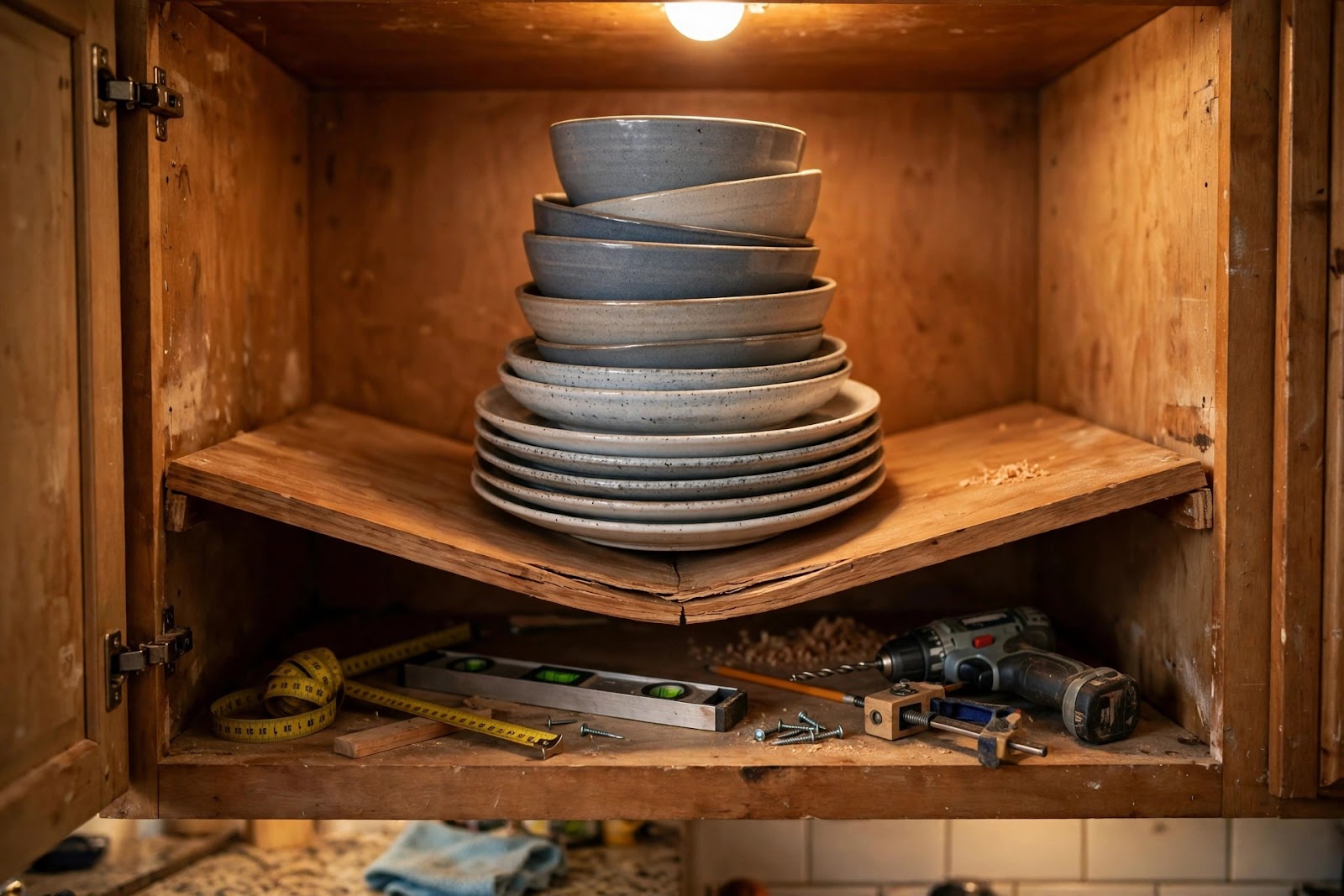
The shopping list was short, and the whole lot came to under twelve pounds. A length of pine batten, roughly forty-four by twenty-one millimetres, from the timber rack at the hardware shop — I bought a 2.4 metre length for about four pounds and had most of it left over. A handful of short wood screws, twenty-five millimetres long, so they would bite into the batten without poking through the top of the shelf. A small tube of wood glue. I already had a drill, a handsaw, sandpaper and a pencil at home. If you are buying everything from scratch, a basic hand drill and a saw will push the total toward thirty pounds, but most of us have those already, gathering dust next to the Christmas decorations.
Measuring was the part I took slowly, because measuring is the part where I usually go wrong. I have cut things too short more times than I care to admit, always in a hurry, always sure I remembered the number. This time I measured the depth of the shelf from the front edge to the back panel three times and wrote it down: fifty-two centimetres. Then I cut the batten to fifty-one, a centimetre short, so it would sit just behind the front edge and not stick out where you could see it or catch a plate on it. I cut it with a handsaw on the kitchen worktop, using a chopping board underneath to protect the surface, which is the kind of improvised workbench arrangement that works fine as long as you clamp things down and do not rush. The cut was not perfectly square — my handsaw work never is — but it did not need to be. It needed to be flat underneath and tight against the shelf above it.
Before I screwed anything in, I did the thing that felt like overkill and turned out to be the whole trick: I jacked the shelf flat. A sagging shelf will not straighten itself just because you screw a batten under it. If you screw the batten on while the shelf is still bowed, you lock the bow in place, and the batten just goes along for the ride. I put a stack of books on the worktop underneath the middle of the shelf — cookbooks, the heavy ones — with a folded tea towel on top, and then I wedged a short length of timber between the books and the underside of the shelf, tapping it gently until the shelf lifted back to level. I checked it with a spirit level. It took three or four small taps, a millimetre at a time, and I was nervous the whole time that the shelf would crack. It did not. Chipboard that has crept over years will usually come back most of the way if you lift it slowly and support it across its width rather than at a single point. Do not force it. If it resists, lift it in stages over an hour, a little at a time. Mine came back to within two millimetres of flat, which was good enough.
With the shelf held flat by the prop underneath, I spread wood glue along the top edge of the batten and pressed it into place under the centre of the shelf, running front to back. The glue is not the main fixing — the screws are — but it stops the batten and the shelf working against each other and squeaking, and it adds a surprising amount of strength once it cures. Then I drilled pilot holes up through the batten and into the shelf, from underneath, two screws near the front, two in the middle, two near the back. Pilot holes matter here. Chipboard splits easily, and a screw driven straight into it without a pilot hole can blow out a chunk of the board, especially near an edge. I used a three-millimetre drill bit for the pilots and drove the screws in slowly, by hand for the last few turns, until the heads sat just below the surface of the batten. I put a small blob of white filler over each screw head afterwards, though honestly you cannot see them unless you lie on the kitchen floor and look up, which I do not recommend as a hobby.
The moment I took the prop away, I held my breath. The shelf stayed flat. I put the spirit level on it again: two millimetres of dip left at the very centre, down from fifteen. Then I reloaded the plates, the bowls, the mugs, all of it, and left it for a week before I let myself believe it. A week later, nothing had moved. A month later, still nothing. It has been nine weeks now, and the plates sit where I put them. The stack has not drifted a millimetre. That is the thing about a fix that works — after a while you forget it is there, which is exactly the point.
I did the same job on the bottom shelf the following weekend, the one holding the pots, and I did it better the second time because I had learned the rhythm of it. The pots shelf needed a slightly different approach because the load is heavier and uneven — a cast iron casserole lives at one end, and that end had sagged more than the other. I put two battens under that shelf instead of one, spaced about a third of the way in from each side, which spreads the load more evenly. It cost an extra four pounds of pine and twenty more minutes. If your shelf carries very heavy things, or the span is wider than a metre, two battens are worth doing from the start. One batten fixes the middle. Two battens fix the middle and the shoulders.
What I got wrong the first time
The first attempt, if I am honest, was not the one I just described. The first attempt was me screwing a batten under the shelf while it was still sagging, without jacking it flat first, because I was impatient and it was already late on a Sunday. I loaded the plates back on, the shelf still dipped about ten millimetres, and I told myself it was better than fifteen and good enough. It was not good enough. The plates still drifted, just more slowly, and after a month the dip was back to thirteen millimetres because the batten had simply bent along with the shelf. I took the whole thing apart, did it properly with the prop and the glue, and the second version has held for nine weeks. The lesson is blunt: a support fixed to a bent shelf supports a bent shelf. Get it flat first, then fix it in place. There is no shortcut around that step, and I tried to find one.

The other mistake was my choice of screws on the first attempt. I grabbed the screws I had in the drawer, which were forty millimetres long, and drove one straight through the batten and out through the top of the shelf. I found out when I ran my hand across the shelf and felt a sharp point poking through the melamine. I had to back it out, fill the hole, and go and buy the twenty-five millimetre screws I should have used in the first place. Measure the combined thickness before you pick a screw. Shelf plus batten, minus a few millimetres of safety. In my case eighteen plus twenty-one is thirty-nine, so a twenty-five millimetre screw bites fifteen millimetres into the shelf and stops well short of the top. It is a small calculation and it saves you a punctured shelf and a trip to the shop.
When a batten is not enough
I should say plainly where this fix stops working. If the shelf is cracked, not just bowed, a batten will not save it. A crack in chipboard runs, and no amount of support underneath will stop it spreading. If the shelf is swollen from water damage — the board puffed up and soft around the edges, the melamine peeling — that board is finished. Replace it. And if the span is over a metre and the load is very heavy, like a shelf full of books, even two battens might not be enough, and you are better off replacing the shelf with plywood or adding a proper vertical divider in the middle. My cupboard shelf was bowed, dry, and uncracked, over a span of eighty centimetres. That is squarely in batten territory. Know which problem you actually have before you pick the fix.
There is also the question of the shelf pins and grooves. Some cupboards hold their shelves on little metal pins in holes drilled up the sides. If your shelf has sagged badly enough, it can pull off those pins at the front, and the shelf can tip. Check the pins while you are in there. Mine were fine, but one was slightly bent, and I swapped it for a spare from the drawer. They cost pennies. A shelf that is level but loose on its pins is still a shelf waiting to drop a stack of plates, and you will not enjoy finding that out at midnight.
Keeping it flat
The fix has held, but I also changed how I load the shelf, and I think that matters as much as the batten. The heavy stoneware now sits near the sides of the cupboard, over the supports, and the lighter bowls and plastic containers live in the middle. It is a small change — thirty seconds of thought when you unload the dishwasher — and it puts the weight where the shelf is strongest. I also stopped stacking plates twelve high. Eight is the new limit. Nobody needs a tower of plates, and the bottom plate of a tall stack carries a surprising amount of weight. Spread the load, keep the heavy things near the edges, and a shelf that has been fixed once will stay fixed.
I check the shelf every month or so now, with the same straight piece of timber and the same ruler. It takes a minute. The dip is still two millimetres, exactly where I left it. If it ever starts moving again, I will know early, while the fix is still a second batten and not a new cupboard. That is the real lesson of this whole job, and it applies to most of the house: small problems announce themselves quietly, months before they become expensive ones. A plate sliding an inch. A mirror staying fogged. A door that needs an extra push. Pay attention to the small drift and you get to fix things with a four-pound length of pine. Ignore it and you end up buying a new cupboard, or repainting a mouldy ceiling, and wondering how it got that bad.
The whole job cost me about eleven pounds, an hour of my time the second time round, and a chipped plate I still think about when I set the table. The cupboard looks exactly the same as it did before — you cannot see the batten unless you crouch down and look up underneath the shelf — and that is how I like my repairs. Invisible, solid, and cheaper than the problem they solve. If your plates have started drifting toward the middle, do not blame your stacking. Lay a straight edge across the shelf, measure the dip, and get a length of pine. Your plates will stay where you put them, and the set your mother gave you will stay a set of six.


